

Intro
My weekly routine is finding and reading new research for Stacy’s Brain. As I segment a big, heavy paper into cards with clear sample and methodology data, I often find disagreements between what different authors say about the same topic.
This is probably one of the most interesting parts of my work — because controversy is where the market hasn’t yet found its efficiency zone, and where additional examination is worth it.
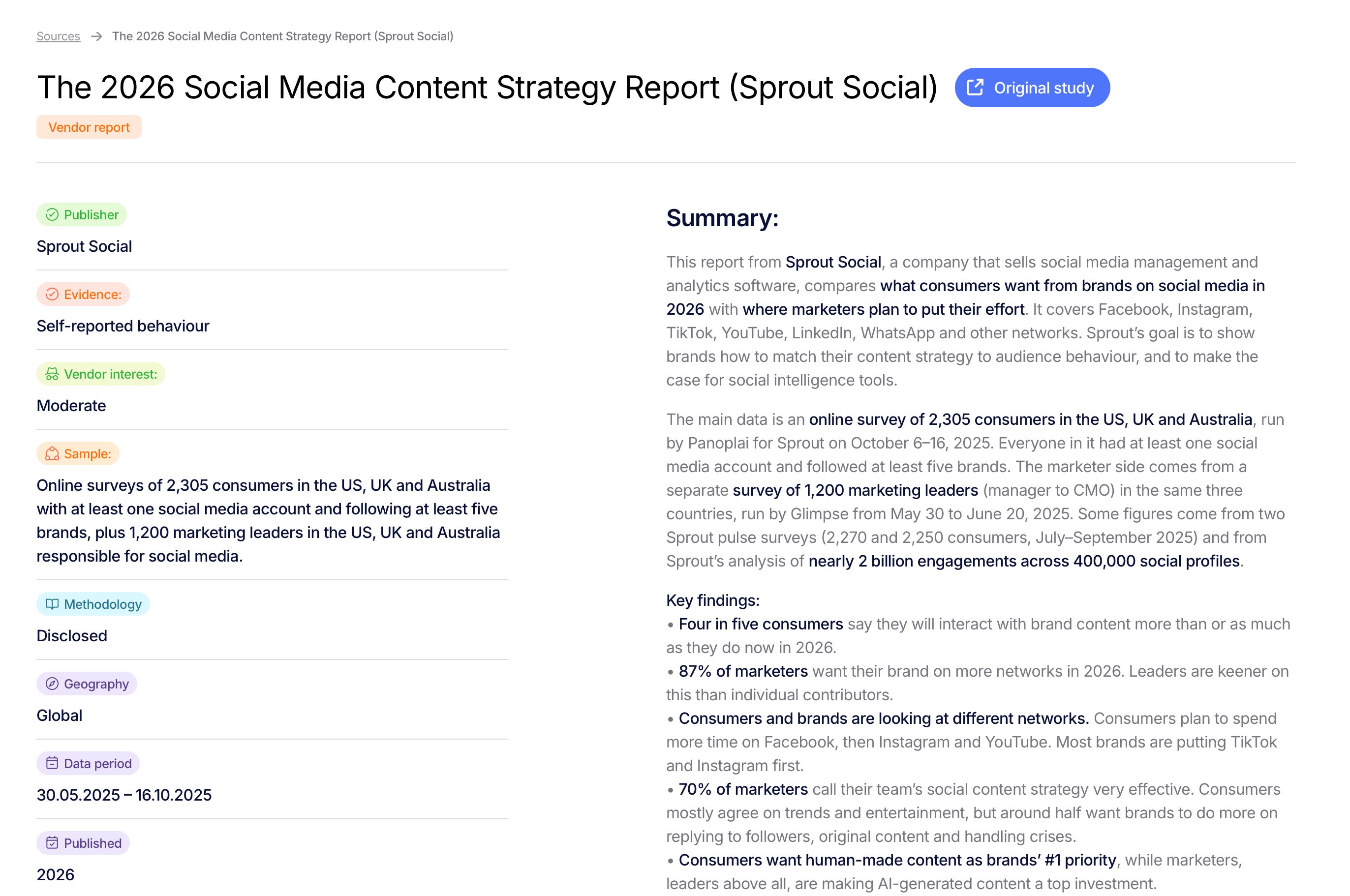
Our “patient report” for today is Sprout Social’s report: 2,305 consumers and 1,200 marketing leaders across the US, UK, and Australia — with a clean headline: consumers and marketers are looking in different directions.
Good, useful report overall. It’s also a survey of what people say.
So we did what we always do: we pulled every finding into our library, graded it, and checked it against what other sources — including those that measure real posts and real campaigns — say about the same thing.
Short version: Sprout is right about a few things that other data confirms, wrong-footed on a couple, and silent on the ones that matter most for budget. Let’s go.
TL;DR
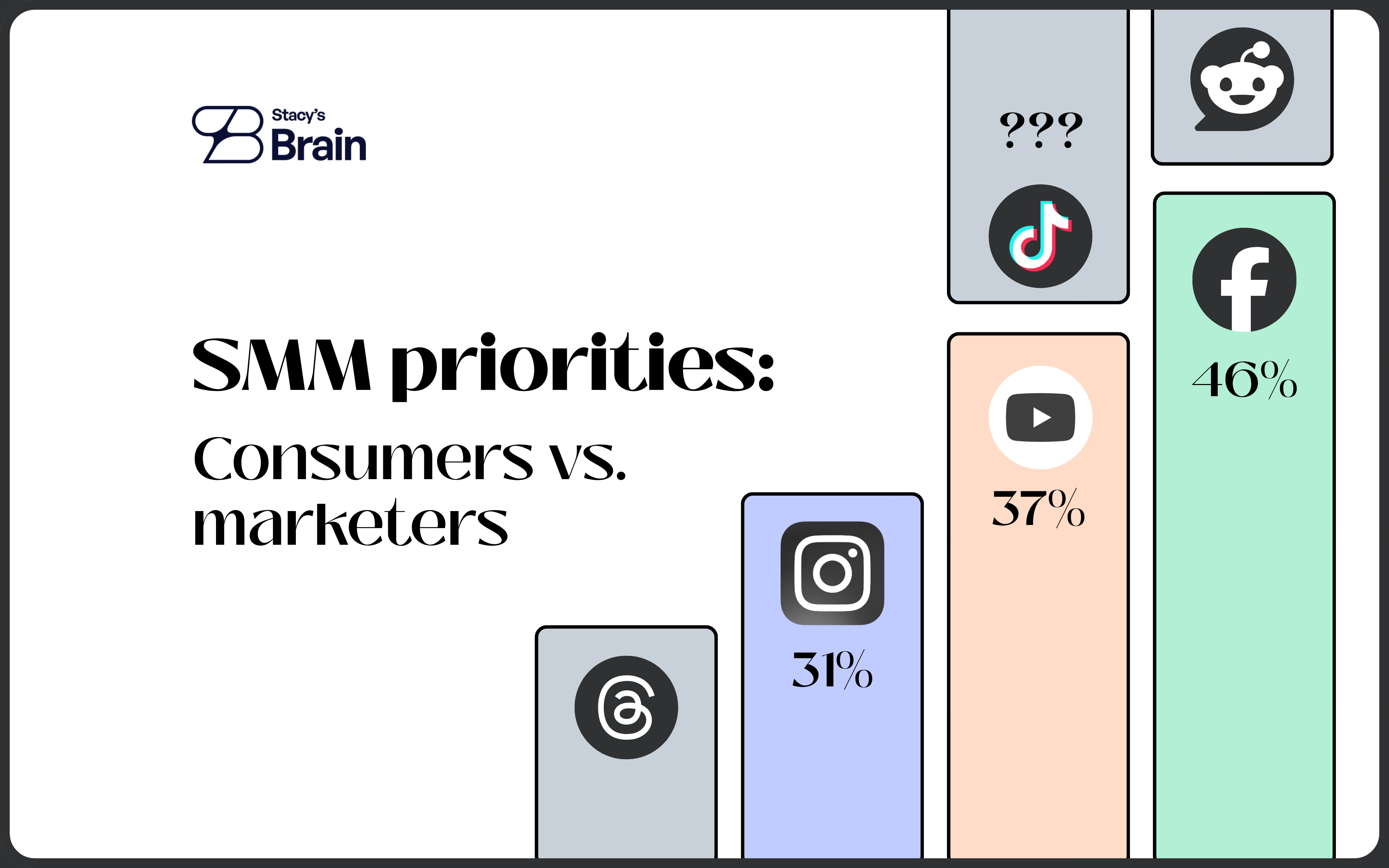
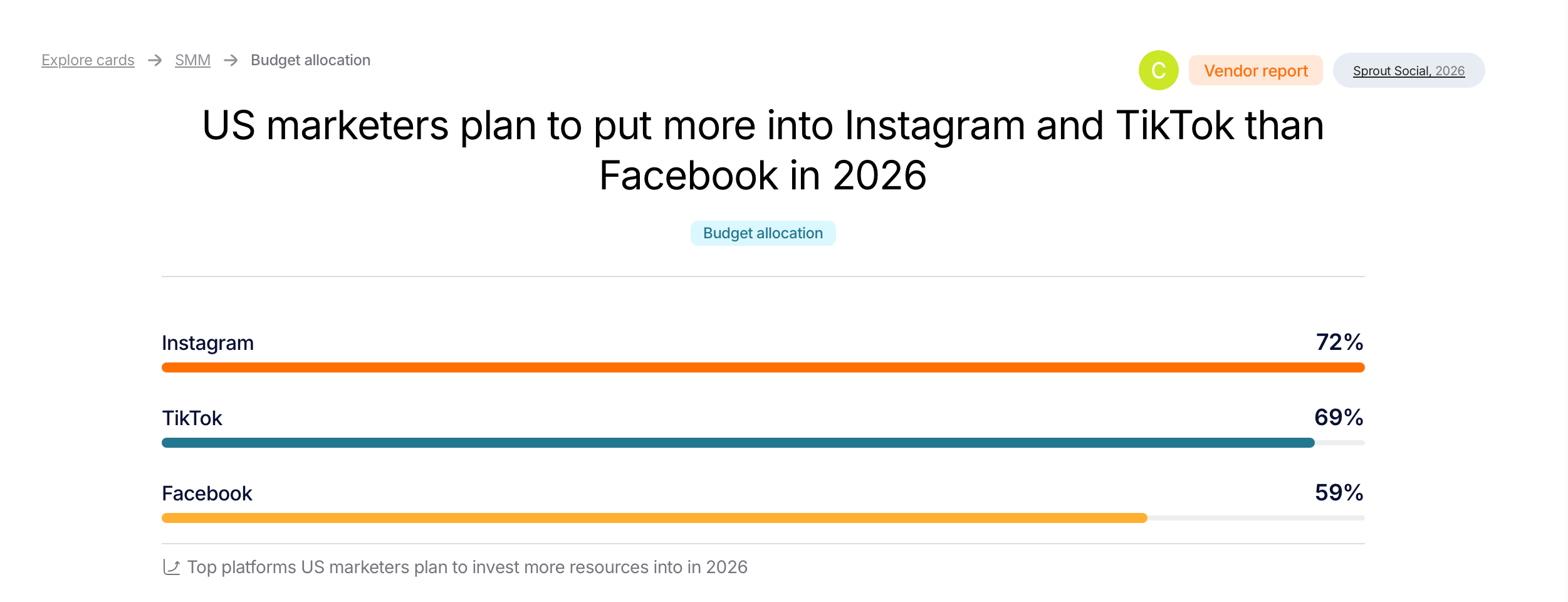
Consumers say they’ll spend more time on Facebook. Marketers are putting money into Instagram and TikTok. In the US, 46% of social users plan more Facebook time, while marketers rank Facebook third (59%) behind Instagram (72%) and TikTok (69%).
But organic brand engagement on Facebook is a fraction of Instagram’s in almost every industry we have data for — fashion brands sat near 0.07% on Facebook against 0.31% on Instagram — and US Facebook CPMs rose 13% in a year. “More time on Facebook” doesn’t mean “more for your brand on Facebook”.
Short video is the one finding every dataset agrees on. Sprout’s consumers pick it first on Facebook, Instagram, TikTok and X; Metricool’s 24M Instagram posts show Reels were the only format whose engagement rate rose in 2026.
Consumers want human-made content; marketers are investing in AI. That gap is real, but smaller than it looks: most social teams use AI for only a minority of posts, and they rewrite what it produces. Use is growing, though — and it may lead to greater marketer-consumer misalignment.
Customer service on social is the gap nobody is staffing — and the alternative data says it should be staffed by people, not a bot.
What this analysis is built on
Main source: The 2026 Social Media Content Strategy Report, Sprout Social, published January 2026.
Consumer survey: 2,305 people in the US, UK, and Australia, run by Panoplai (6–16 October 2025). All respondents had at least one social account and followed at least five brands.
Marketer survey: 1,200 marketing leaders (manager to CMO) in the same three countries, run by Glimpse, 30 May – 20 June 2025.
Two pulse surveys (2,270 and 2,250 consumers, July–September 2025) supply the “where will you spend more time” numbers.
Three things to hold in your head for every number below.
First, this sample is now about a year old. Some trends — such as the use of AI-generated content — have likely increased since the survey was conducted.
Second, the consumer sample is people who follow five or more brands. That’s a sample that already likes interacting with brands, so expect every “how often do you engage” figure to run high.
Third, almost everything here is self-reported — “the content type I’m most likely to interact with”, “the network I plan to spend more time on”. These are preferences and intentions, so where we found measured data on the same question, we put it next to Sprout’s.
What we checked it against, all graded in Stacy’s Brain:
Metricool Instagram study 2026 — 24.4M posts from 375K accounts, Jan–Feb 2025 vs Jan–Feb 2026. Evidence type: observed. Vendor interest: moderate.
Socialinsider content trends 2026 — 23M Facebook and 33M Instagram brand posts across 16 industries, 2025. Evidence type: observed. Vendor interest: high.
HubSpot State of Marketing 2026 — 1,505 marketers, September 2025. Evidence type: self-reported. Vendor interest: moderate.
Tinuiti Q2 2026 digital ads benchmark — $4B+ in managed ad spend. Evidence type: observed. Vendor interest: high.
Gartner customer chatbot survey 2026 — 3,566 B2B and B2C customers, Feb–Mar 2026. Evidence type: stated intention.
Plus smaller pieces from Sociality.io, Promptwatch and an independent Reddit-and-AI study.
The Facebook paradox
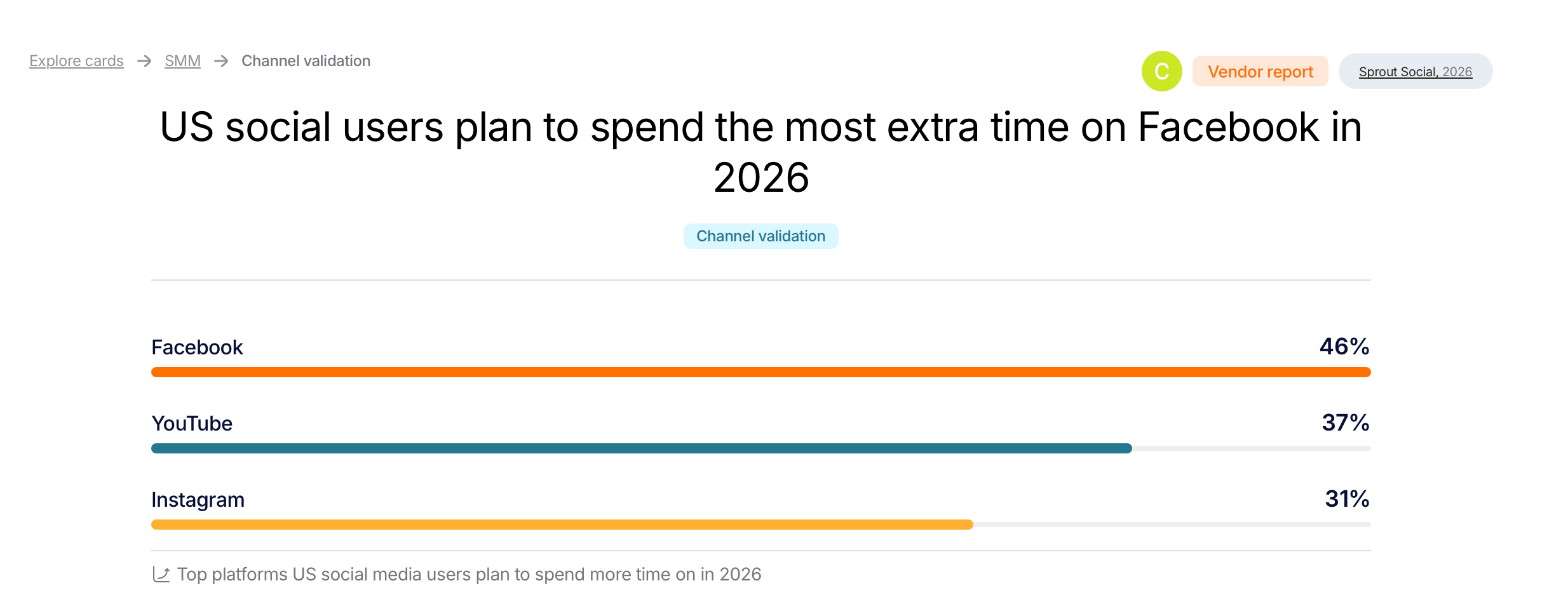
Ask consumers where they’ll spend more time in 2026, and Facebook comes first in all three countries, according to Sprout:
US: Facebook 46%, YouTube 37%, Instagram 31%
UK: Facebook and Instagram tied at 34%, TikTok and WhatsApp 29%
Australia: Facebook 37%, Instagram 27%, YouTube 25%
Ask marketers where they’ll invest more, and Facebook drops — except in Australia:
US marketers: Instagram 72%, TikTok 69%, Facebook 59%
UK marketers: TikTok 73%, Instagram 69%, Facebook 64%
Australian marketers: Facebook 79%, TikTok 70%
And then, a twist:
70% of the same marketers say Facebook has the biggest business impact of any platform. So they believe Facebook pays, consumers say they’re going there, and the budget still flows elsewhere.
Sorry, wtf?
Sprout’s reading is that brands are chasing the shiny networks. That likely misses some context: money invested and business impact are not the same thing.
My reading is that, for most brands in the US and UK, a Facebook presence is either already established or easily won. There may already be a brand-to-customer layer that’s taken for granted, simply because buyers have a habit of tracking brand news on Facebook.
By contrast, Instagram and TikTok may be the newer, still-untapped zones where marketers are trying to build relationships with potentially younger audiences and the next generation of customers. So it’s normal that a higher percentage of budget is invested there.
So the headline “controversy” in Sprout might actually be logical.
But let’s not rush to conclusions.
Here’s what the rest of Stacy’s Brain library adds.
Marketers elsewhere say the opposite about ROI
In HubSpot’s survey, the share calling Facebook their highest-ROI social platform fell from 54% to 43% in a year, while Instagram rose to 48% and took the lead.
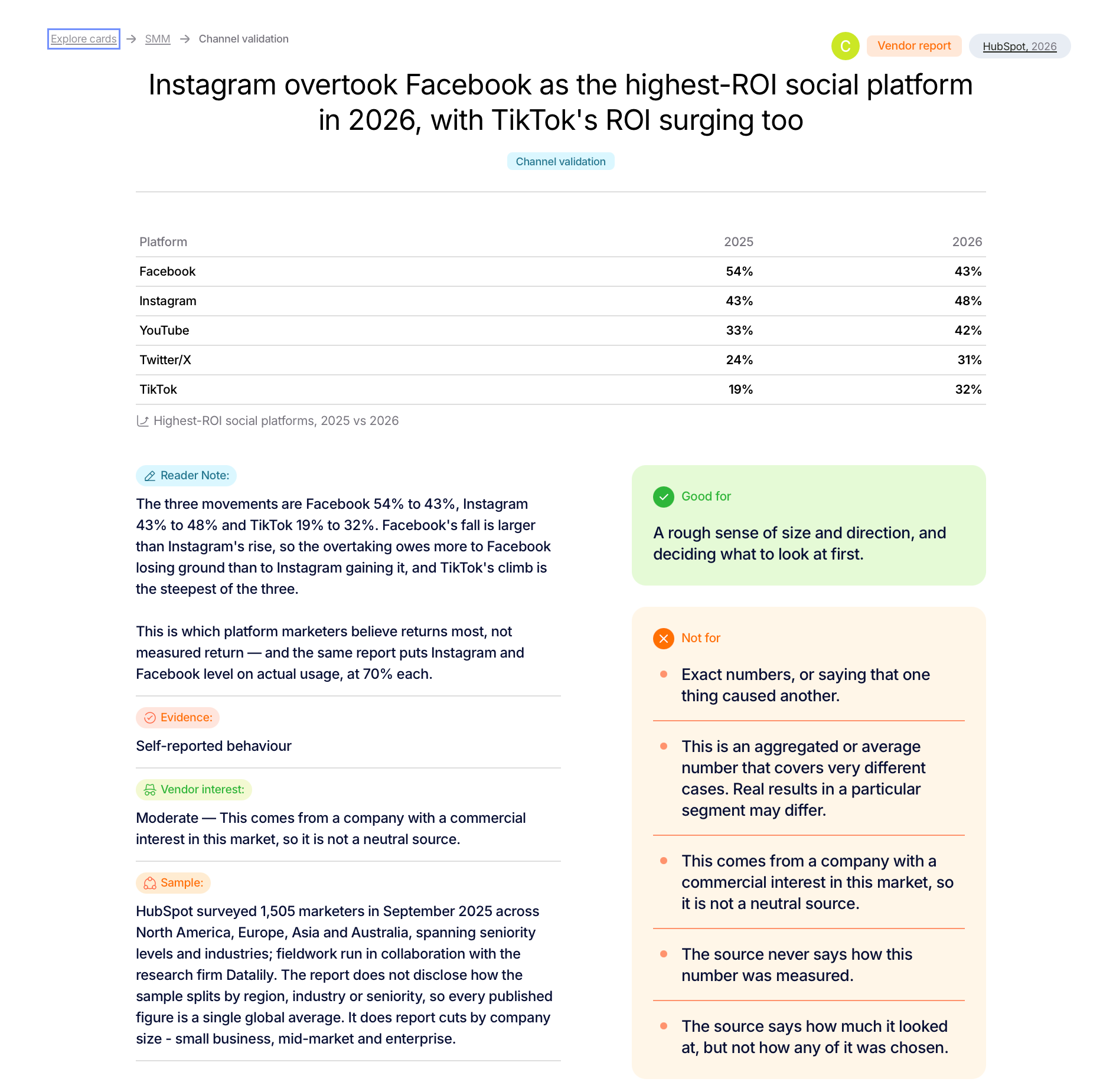
It’s a different survey and a different question (“highest ROI” vs. “biggest impact”), but it’s still hard to square with Sprout’s 70%.
Organic brand engagement on Facebook is low
Socialinsider’s 2025 data on 23M Facebook brand posts puts Facebook below Instagram in almost every industry. By Q4, the leading content theme sat at roughly:
Fashion: 0.07% on Facebook vs 0.31% on Instagram
Tech & software: 0.14% vs ~0.40%
Education: 0.15% vs 0.50%
Travel: 0.11% vs ~0.40%
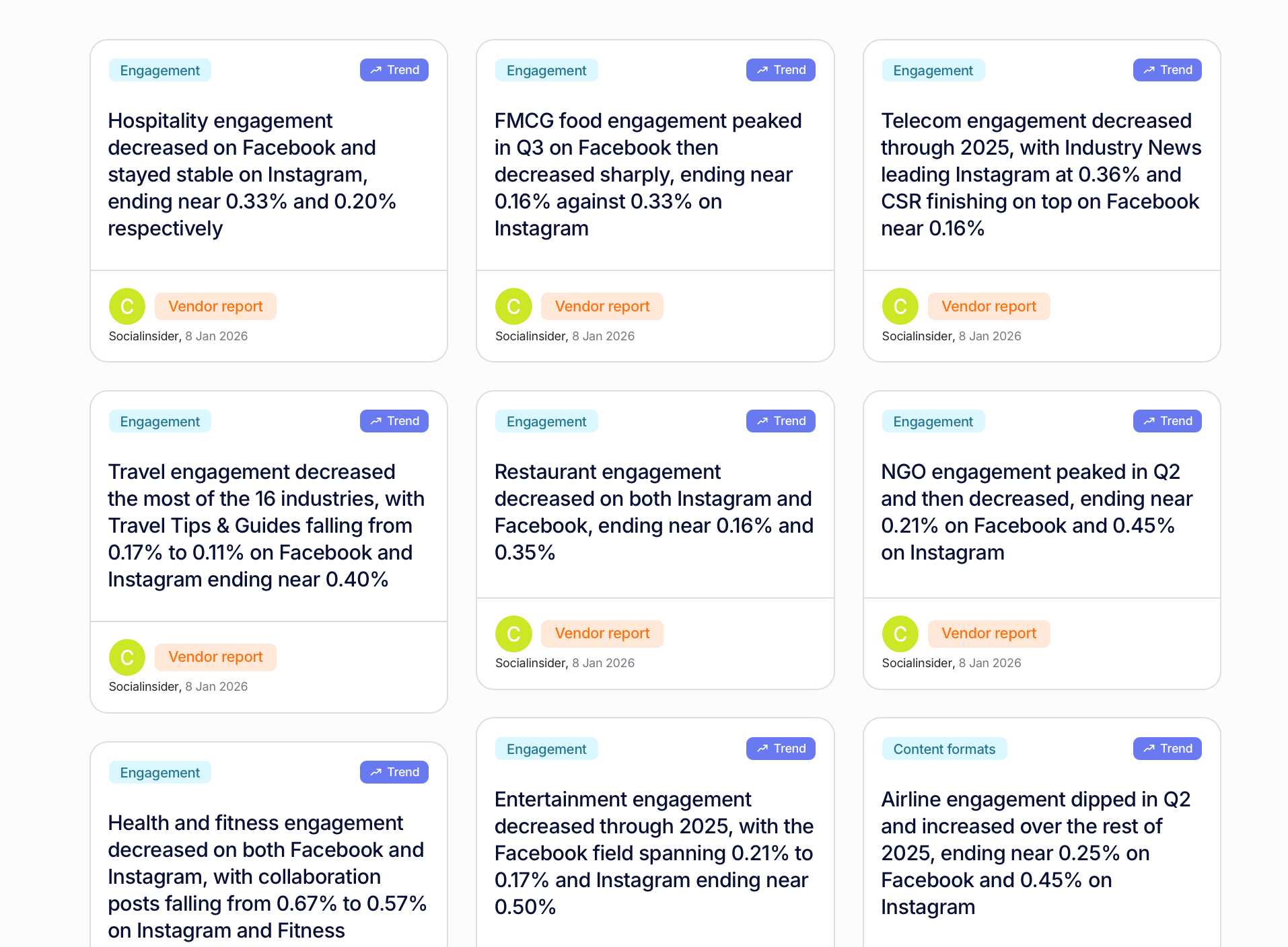
Hospitality was the clear exception, at about 0.33% on Facebook against 0.20% on Instagram.
Margin note: Don’t treat Socialinsider’s data as hard fact. Engagement rate isn’t calculated the same way on Facebook and Instagram—but the gap is too large and too consistent to be a rounding issue.
Plus, paid reach on Facebook is getting pricier
Tinuiti saw US Facebook CPMs rise 13% year over year in Q2 2026, the fastest of the five platforms it tracks. Instagram held flat.
How we’d read it (taking into consideration all data we have)
Consumers spending more time on Facebook is believable — but they’re telling you where they’ll be, not that they want brand posts there.
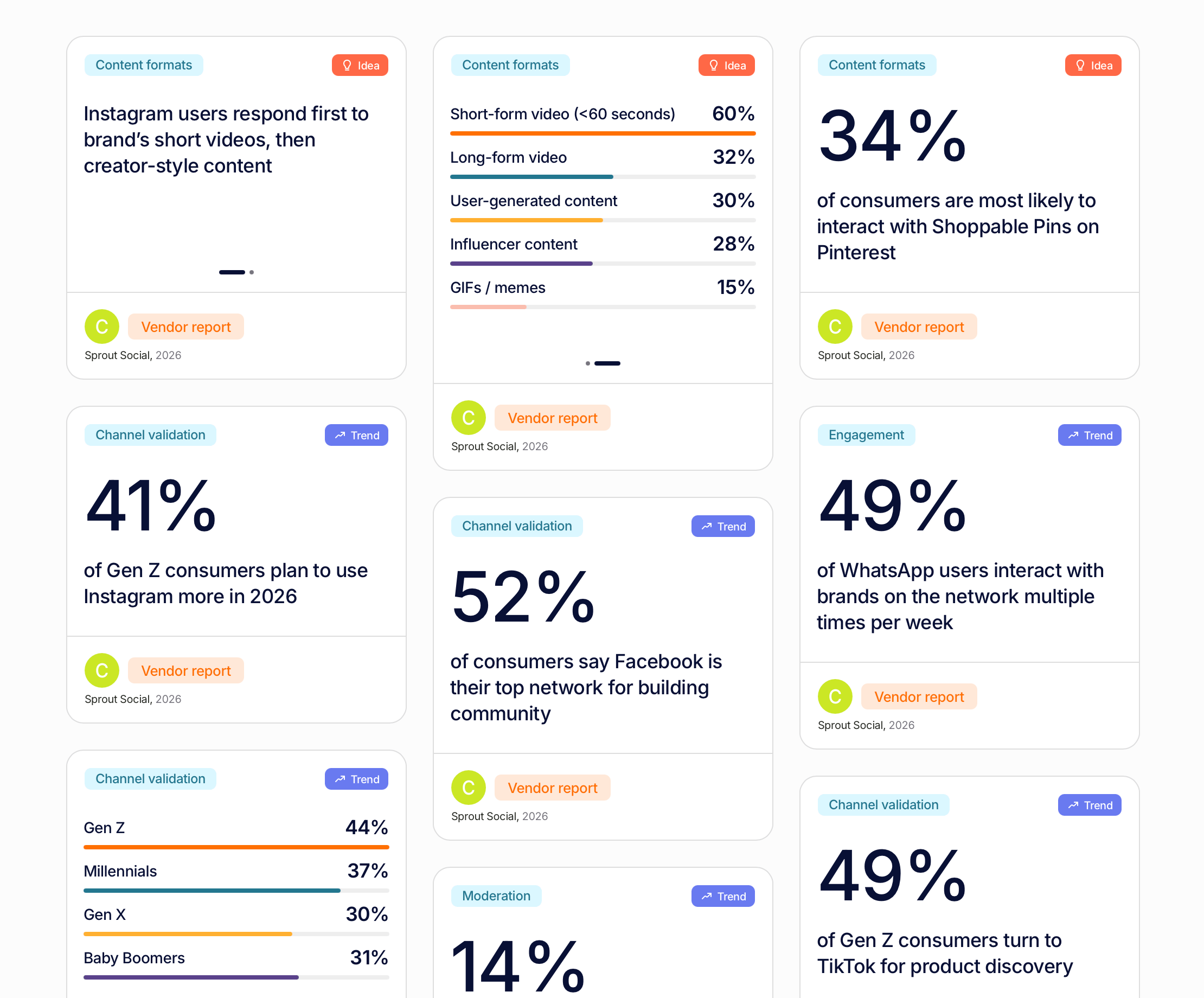
Sprout’s own data shows what they go to Facebook for: product discovery (nearly 40%) and community (52% call it their top network for community). So Facebook earns its place for groups, customer service and paid discovery, not for organic brand publishing.
The marketers shifting organic effort to Instagram aren’t necessarily wrong — as I earlier mentioned, they are likely to have a reason to invest into Instagram and TikTok.
Short video is the lead format for SMM
Sprout asked which brand content people are most likely to interact with on each network. Short-form video (under 60 seconds) wins almost everywhere:
TikTok: 60%
Instagram: 52%
Facebook: 48%
X: 37%, just edging past text posts at 36%
YouTube: short 52%, long 49% — practically level
The exception is LinkedIn, where text posts lead at 51% and short video sits at 27%.
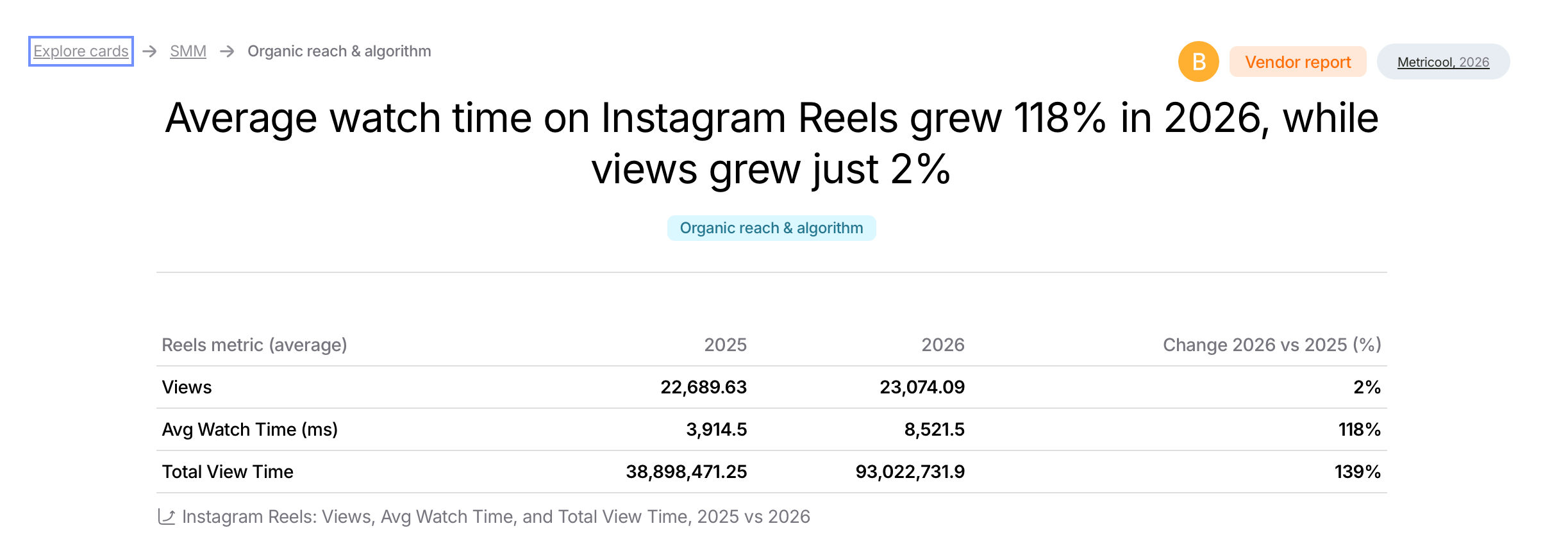
This is the rare self-reported finding that measured data backs up. In Metricool’s Instagram study, Reels were the only format whose engagement rate rose in 2026 (up 24.76% to 4.30%), Reels shares grew 67%, and average watch time more than doubled (+118%) while views barely moved (+2%).
Human-made vs. AI-made: a real gap, growing each month
In my opinion, Sprout’s most important finding is that consumers rank human-made content as brands’ #1 priority for 2026, while marketers — leaders especially — are making AI-generated content a top investment.
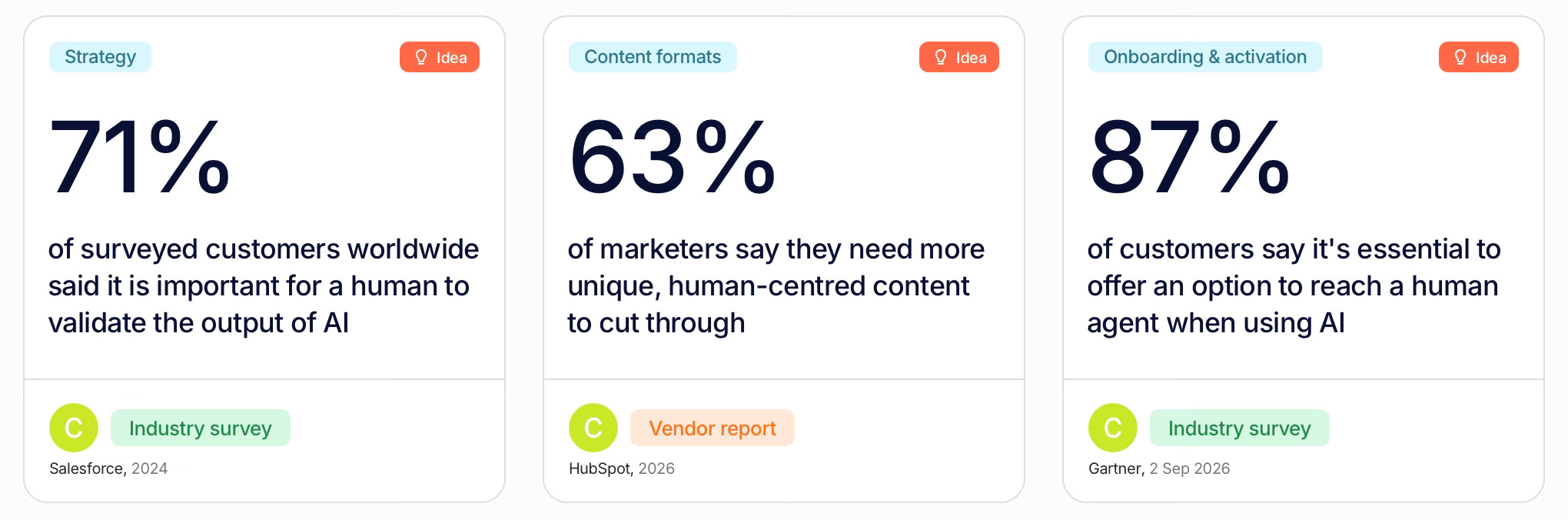
The consumer side is consistent with insights from other reports. In HubSpot’s survey, 63% of marketers say they need more unique, human-made content to stand out, and 53% say they struggle to stand out in an AI-saturated market. Nobody is arguing that AI slop works.
What the “marketers are betting on AI” framing misses is how they use it.
Since I’m the kind of marketer who automates a lot with AI, I can confidently say that content is the last thing you should try to automate. The devil is in the details, and while 100% content automation is tempting, it’s usually more damaging than helpful.
The current consensus is that AI is best used for data analysis, drafting, and expanding the range of “potential options.” Final review, reasoning, and bias checks should stay human — so you don’t lose reader attention.
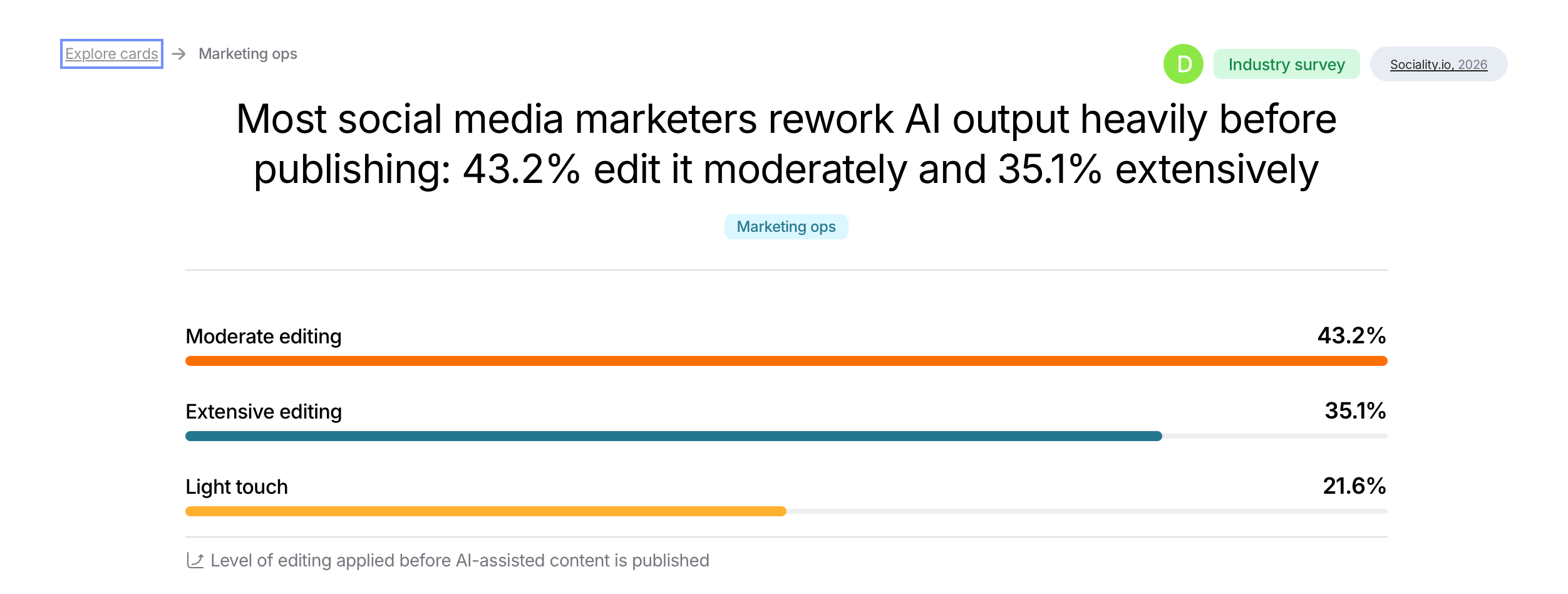
In Sociality.io’s survey of social teams, AI touched under a quarter of posts for the largest group, and 78% said they edit AI output moderately or extensively before it goes out (the question didn’t offer “we publish it unedited” as an answer, so that share is unknown).
Brands are good at the thing that matters least
Sprout’s report has another finding that deserves more attention than Sprout gives it. When consumers rated how brands are doing on social:
Keeping up with trends and cultural moments: 70% say excellent or good
Entertaining content: 69%
Truly original content: 56%
Responding to crises: 51% — the weakest mark
Meanwhile marketers are pouring effort into speed on trends: 75% can get trend content approved within five hours. Only 30% say at least half their content is timely or tied to cultural moments — but among teams with 650K+ followers that rises to 44%, so the bigger the account, the more of it goes on trends.
But (!) trends are table stakes — consumers already think brands handle them fine. The gap is originality, which links straight back to the human-made point above, and crisis response, which is a process problem (who can post, how fast, with what sign-off), not a content problem.
If you have one extra hour a week, spend it on original work.

The customer service gap nobody is staffing
Sprout’s second-biggest consumer ask: personalized customer service is consumers’ #2 priority, and it doesn’t appear on marketers’ priority list at all.
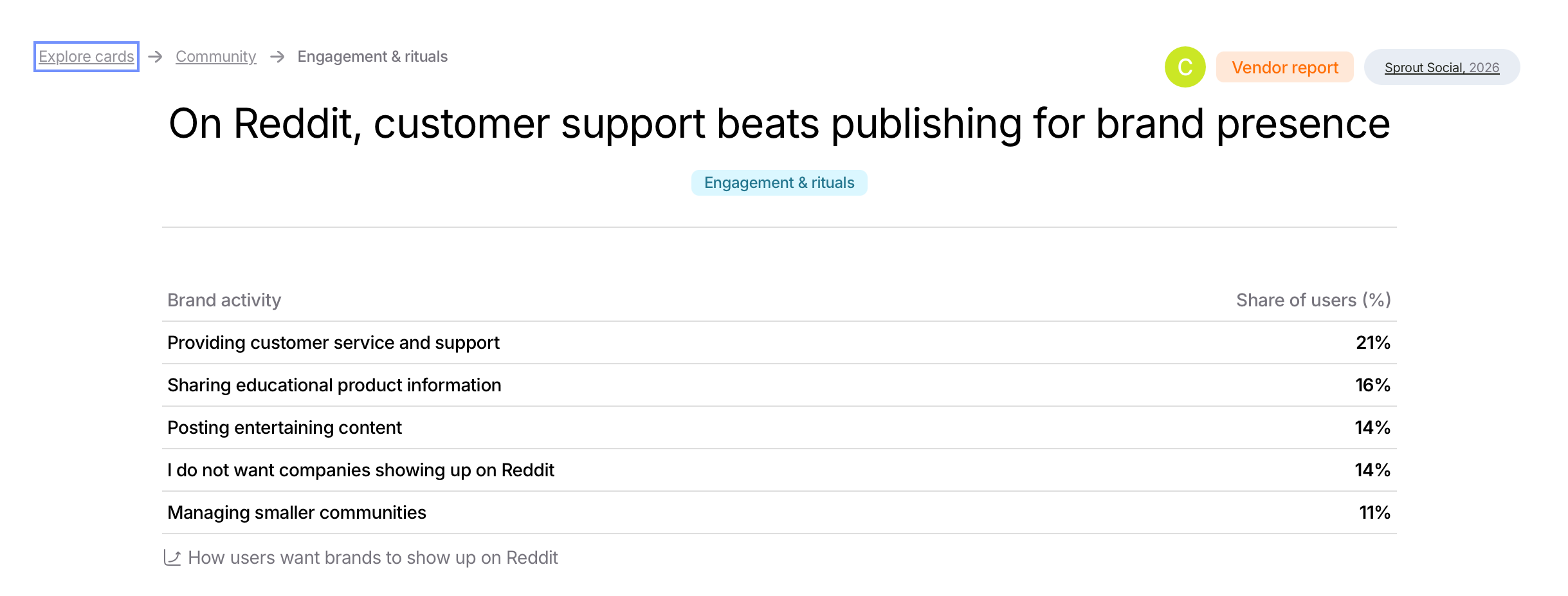
Customer service is what users most want from brands on Reddit (21%) and WhatsApp (40%), and 18% of users say they turn to LinkedIn before any other network when they need help — another 18% say the same of X.
Tempting first thing? Fix this with an AI chatbot. Luckily I have a great Gartner’s 2026 customer survey I can reference:
Only 27% of customers would try a chatbot again after a bad experience.
87% say it’s essential to have an option to reach a human.
53% say they’d consider switching to a competitor if they learned a company uses AI for customer service.
Social customer service is a real, unclaimed advantage, and it has to have a person behind it. If you’re a small team, that’s your edge: you can answer as a human when a bigger competitor relies on machines.
Reddit: support desk, not stage
Sprout’s Reddit data is short. Users want brands there for customer service (21%), then product information (16%). 14% don’t want brands on Reddit at all, and 54% are most likely to engage with user-generated content rather than brand posts.
Stacy’s Brain knowledge adds a reason to care about Reddit that Sprout doesn’t touch: AI search.
An independent study across 12 product categories found that the brands Reddit communities rate highest are, on average, the brands AI chatbots recommend most (rank correlation 0.554, falling to 0.430 when the brand list was built independently of the AI answers). Google’s AI Mode linked to Reddit in 70.8% of “is it worth it” and comparison questions.
I shared a detailed post on this in our Telegram community GTM in Public. If Reddit and AI citations are your topic of interest, you can find it there.
So in my opinion, on Reddit, the value isn’t in what you post — it’s in what users say about you.
Stacy’s Brain reads marketing research so you don’t have to, grades every source for methodology, sample and vendor interest, and tells you how far to trust each number.