

Intro
November is a season of spooky movies, Black Friday sales and next-year trend reports. The data is in, and researchers are already turning it into projections. There’s just one thing about projections: they never align. Forrester says one thing, Gartner another, and each gets its own headline.
Some themes show up in almost every forecast, which is about as close to consensus as this industry gets. Others point in opposite directions.
So I went through 41 sources: 11 forecasts, 14 studies from the Stacy’s Brain library and 16 outside surveys, benchmarks and case studies (the full list is at the bottom). Then I did three things:
Put the forecasts side by side and grouped them by theme.
Listed everything else they predict, by category.
Wrote my own predictions, built from our library and what we see in our agency work.
TL;DR
AI enters its efficiency era, and it gets expensive. Forrester expects marketers to scale back ~30% of their AI initiatives as usage-based pricing kicks in.
But the AI budget is splitting in two. Money for AI tools is under pressure, while money for being visible in AI keeps growing: a net 75% of marketers plan to invest more in AI assistants next year.
CMOs who don’t understand AI get replaced. Gartner predicts that a lack of AI knowledge will become one of the top three reasons large companies replace their CMO.
Trust becomes the competitive edge. It’s the one theme every forecaster agrees on, and the stakes are concrete: Forrester expects 2/3 of B2B providers to lose deals because buyers’ AI tools find their claims weak or hard to verify.
AI agents enter B2B buying, but only for the routine part. Forrester expects 75% of business buyers to use agents for buying tasks.
Brand budgets need a sales story. Gartner predicts over 40% of CMOs who push for bigger brand budgets will lose influence in the C-suite.
The AI layoffs went too far. Forrester expects CX teams to grow 20% again after what it calls “overzealous cuts”.
Ad money moves to streaming, retail media and creators. Linear TV keeps shrinking, social slows to single-digit growth, and Forrester expects at least three big streamers to launch free, ad-supported tiers.
Plus, my predictions:
PR and link building will have their renaissance and become one of the core AI-optimization channels.
Banner blindness reaches creators, and the influencer bubble starts to deflate.
Customer development and access to power users become a scarce asset and a fair advantage.
Founder-led and team-led growth move to the front.
Anti-AI content becomes a positioning.
In-app partnership ads grow, guerrilla-style.
Ready to explore?
The big themes for 2027
1. AI gets an invoice
In 2026, AI was a fun experiment, and few companies seriously questioned its ROI. In 2027, novelty is no longer an advantage, so it’s time to make sure the math is on your side.
That’s the loudest message in this year’s forecasts.
Forrester’s B2C predictions put it bluntly: “exorbitant AI economics will force marketers to scale back a third of AI initiatives”. The reason is pricing. AI vendors increasingly charge per use, so every agent run and every generated asset now shows up on an invoice.
Leadership has noticed: in Forrester’s Q3 2026 CMO pulse, 82% of US B2C marketing executives expect to justify future AI spend more strongly than before. Forrester also expects AI agents to replace legacy marketing and insights tools (survey platforms, social listening dashboards, campaign reporting tools) at one in 10 companies.
Gartner sees the same problem from the people side.
65% of CMOs expect AI to dramatically change their role within two years, but only 32% think the role needs major new skills. Gartner predicts that by 2027, a lack of AI knowledge will be one of the top three reasons large companies replace their CMO.
And I have an explanation for why the bill is arriving now.
McKinsey found that 90% of CMOs are experimenting with AI, but fewer than 10% have scaled it across their workflows.
The CMO Survey puts the self-reported productivity gain at about 14%: real, but a long way from the transformation the budgets were sold on.
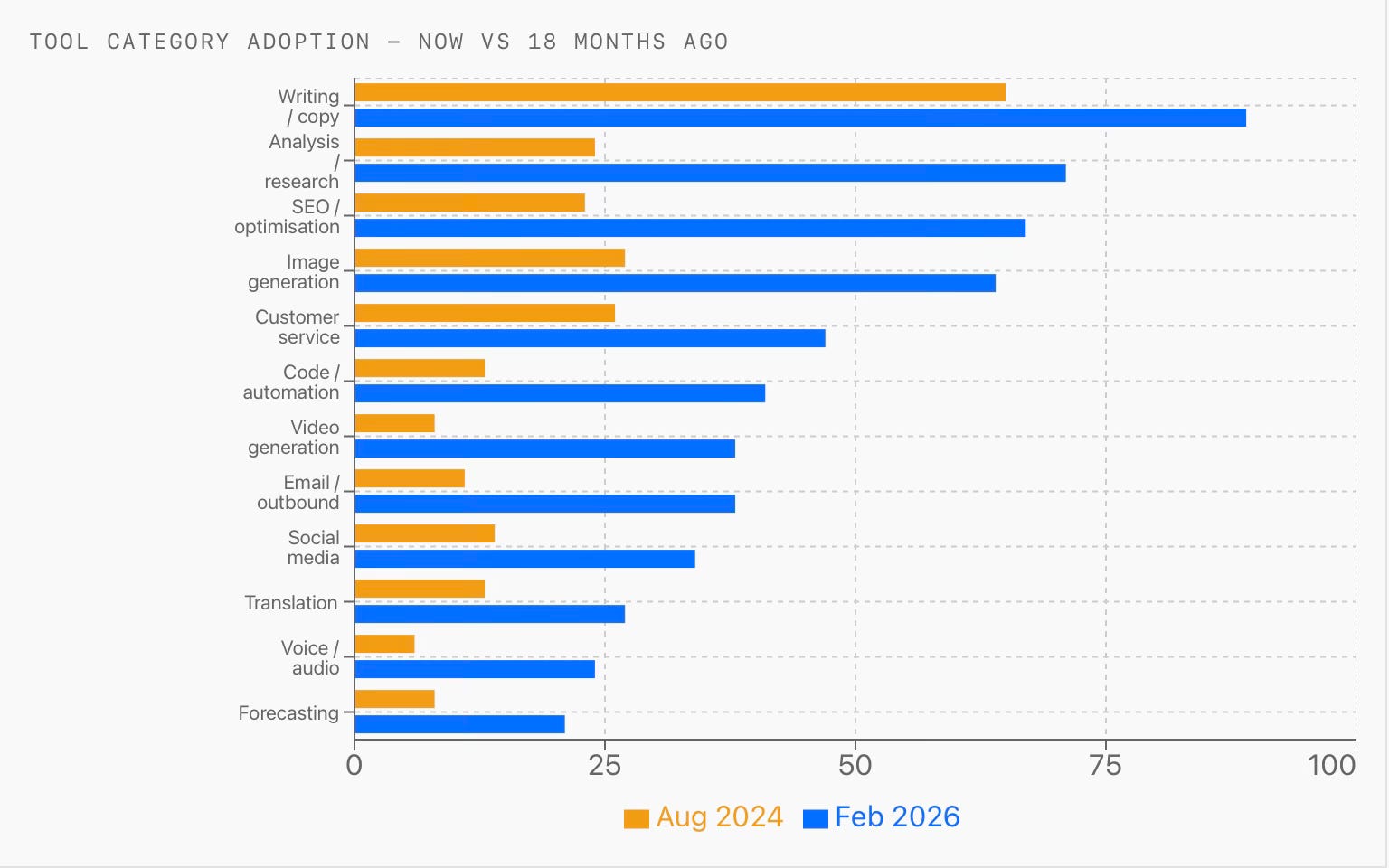
And the mood is already turning. In CMI and MarketingProfs’ 2027 B2B survey, the share of B2B marketers planning to invest more in AI marketing tools fell from 45% for 2026 to 30% for 2027.
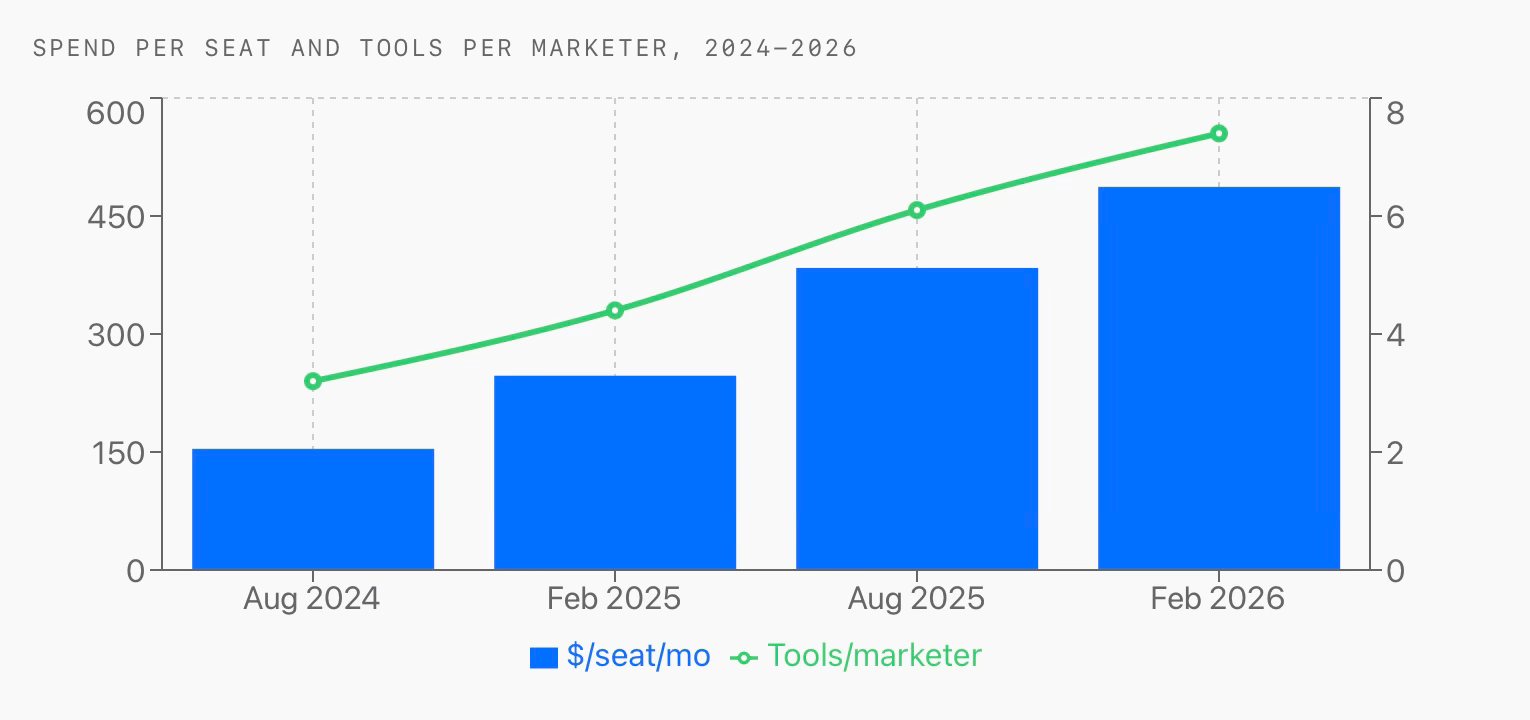
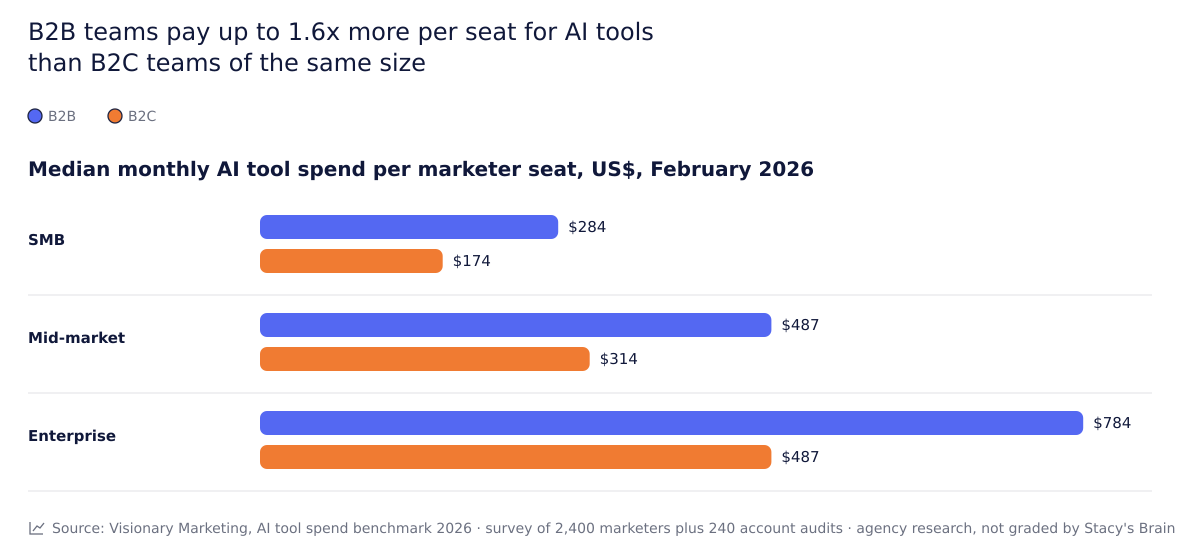
How much does it cost? In Visionary Marketing’s benchmark, a B2B marketer’s seat costs up to 1.6x more in AI tools than a B2C seat at a company of the same size. For scale, Gartner’s 2026 CMO Spend Survey puts AI at 15.3% of the average marketing budget.
Now for the part that looks like a contradiction.
Forrester says marketers will spend less on AI in 2027.
Kantar’s Media Reactions 2026 says a net 75% of marketers plan to spend more on AI assistants in 2027.
Same year, same “AI”, but (!) opposite directions.
Imo, they’re not describing the same money. Forrester is talking about AI inside marketing: tools, agents and content generation, each billed per use. Kantar is talking about being visible to AI: showing up in ChatGPT’s and Gemini’s answers, and buying ads there.
So my reading is that 2027 cuts the first budget and grows the second. If your AI spend is one line in the plan, I’d split it before your CFO does it for you.
2. Trust and proof become the product
This is the strongest consensus in the whole set.
100% alignment.

Forrester expects human-made content to become a top priority again for 50% of brands, and a third of consumers to reject content that can’t prove its source. Its advice for 2027 is to win by being “the most trusted, not the most automated”.
On the B2B side, Forrester’s B2B predictions go further: two thirds of B2B providers will lose deals because buyers’ AI tools find their claims weak or hard to verify. Gartner adds that by 2027 brands will put half of their influencer budgets into content and creator authenticity.
Honestly, I felt this, and it’s one of the reasons I started building Stacy’s Brain. As long as marketers delegate market research to LLM models, the outcome they produce will have no moat and will keep relying on the same unvalidated vendor bullshit.
We’ve encountered it many times: “Cold emails are a top-ROI thing” is a claim that comes from vendors, not users. But LLMs do not care; if something is cited, it’s trustworthy — and here’s how a sales line from someone gets into your plan.
That’s a margin note, though; let’s get back to the topic.
“Trust” sounds soft, but I think the mechanism behind it is concrete. Buyers, and now their AI tools, check you against everything said about you. Proof you control (case studies, named authors, clearly labeled AI use) matters, and proof you don’t control (reviews, references, third-party lists) matters even more.
3. Buying moves into AI conversations, at very different speeds
Another 100% aligned claim: shopping and buying are moving into chats and agents. They disagree on the speed, and the speed depends on who’s buying.
Forrester expects only 1 in 20 US and UK consumers to switch from traditional shopping to AI conversations in 2027. Most people will browse AI shopping tools for fun and drift off; the few who stick, mostly Gen Z, will hand routine “subscribe and save” purchases to agents.
Business buyers are a different story: Forrester’s B2B team expects 75% of them to use AI agents for specific tasks like supplier search and RFP drafting.
Gartner sits in between, with 60% of brands using agentic AI for one-to-one interactions, but only by 2028.

So… what does that actually mean for B2B?
A margin note on Forrester’s data. I don’t think we’re talking about full B2B purchases. Checking a vendor’s deck or proposal, comparing suppliers, drafting an RFP: yes, agents will definitely do that. But big contracts won’t be signed by an AI. They involve legal review, several stakeholders and trust that gets built between people.
Where agents already buy on their own is the small, routine, rule-based part of B2B spending:
Tail-end supplier deals: Walmart used Pactum’s negotiation chatbot with tail-end suppliers (fleet services, carts, store equipment) whose standard terms had never been negotiated. It closed deals with 64% of the 100 suppliers it approached, against a 20% target, with 1.5% average savings and payment terms extended to 35 days (Talking Logistics, citing Harvard Business Review). In 2026, Ahold Delhaize USA started piloting the same approach for indirect spend, while keeping “full oversight of each negotiation and interaction” (CPO Strategy).
Automatic store replenishment: Migros runs AI-generated store orders across 2,000+ stores and 30,000 SKUs. Its vendor reports inventory days down 11% and availability up 1.7% (invent.ai case study, vendor-reported).
Office and operational purchases: Amazon Business, which serves more than 8M organizations, is adding AI that flags savings and unusual spending, plus AI agents that manage orders and forecast demand for manufacturers (Amazon).
Same pattern everywhere: low value per order, clear rules, and a human who sets the guardrails. So if you sell B2B, assume an agent will read and compare your offer before a person does, and make your claims easy to verify.
4. CMOs have to prove it, or lose the room
All forecasters agree that budgets will follow proof of impact, and that most teams can’t produce it yet.
I can confidently validate this one from the agency side. We increasingly see that awareness and brand equity get bought only when they show a real path to money. Without it, most visibility initiatives get shut down. So yes, marketers need to start counting ROAS and make it their main KPI.

At the same time, from the marketer’s side, this is hell.
With AI search reshaping discovery, most people, especially in startups, don’t know which channels will work right now. And the ones that clearly will (SEO, AEO, founder-led growth) are long-cycle channels that won’t show ROAS in a quarter.
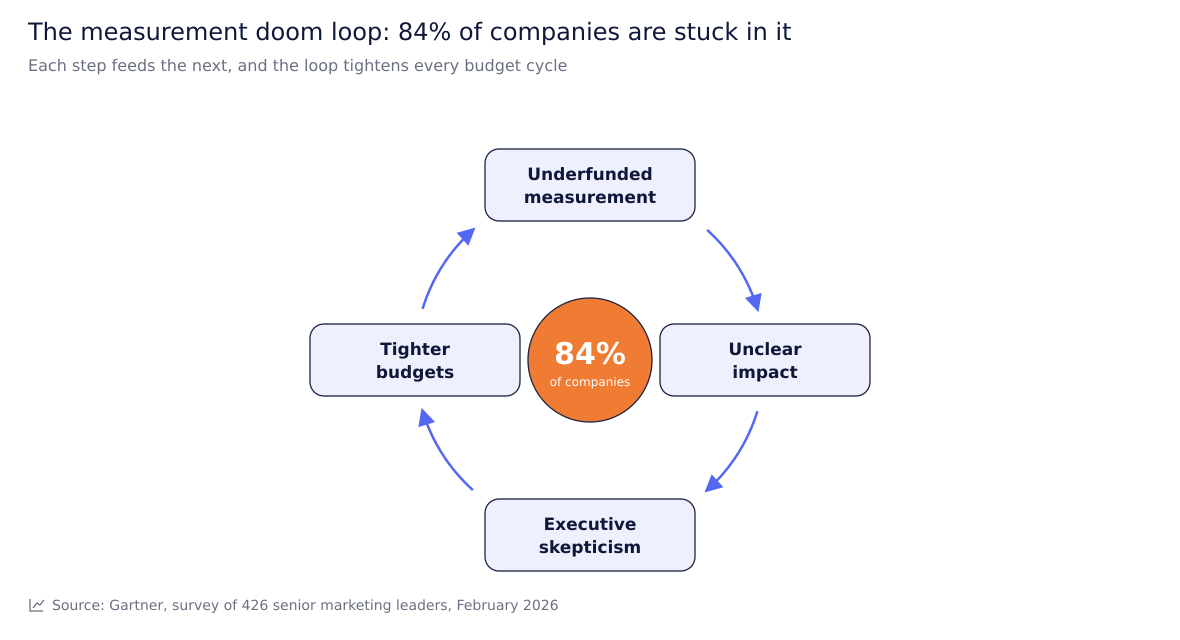
Gartner predicts that by 2027, over 40% of CMOs who push for bigger brand budgets will lose influence with the C-suite because they can’t show returns. Its survey describes a “doom loop” at 84% of companies:
Marketers feel the pressure.
In Nielsen’s 2026 marketing report, 52% name sales lift and ROI as their top goal for next year, and the share of US marketers expecting budget cuts jumped from 2% to 14% in a year.
The IAB’s September outlook shows the same shift among ad buyers, with customer acquisition seeing the biggest jump of any goal since January.
And here’s the controversy.
Everything in the previous sections says we need to build trust, and trust is basically brand equity. Yet companies are ready to fund only initiatives with a clear ROAS. So a smart marketer stops choosing between the two and builds combined funnels, where brand and sales tactics work in one plan.
Nielsen’s own analysis backs this up: campaigns that combined brand and sales tactics delivered 1.5x the sales lift of awareness-only campaigns. The CMO who loses the room in 2027 is the one defending brand as a category. The one who keeps it shows brand and sales working together, with a number attached.
5. The AI layoffs overshot
Here two Forrester reports point the same way.
On the CX side, Forrester expects staffing to grow 20% after “overzealous cuts”, with new hires in AI-supporting roles like data scientists and AI experience designers.
On the B2B side, it warns that some marketing teams will cut up to 25% of roles too early, betting on productivity gains that don’t fully arrive.
Gartner adds a structural twist: by 2028, half of CMOs will move to a “composable” organization, meaning smaller AI-assisted teams drawing on a shared pool of specialists.

And again, this is very logical.
The productivity gains that justified the cuts are modest so far: the 14% in The CMO Survey, and McKinsey’s fewer than 10% of CMOs who’ve scaled AI. Meanwhile Nielsen finds that 34% of US marketers already act on AI recommendations without human review (oh no).
So if 2026 was “AI replaces people”, I expect 2027 to be “AI needs people to run it”: hiring for data, measurement, QA and editing.
6. Ad money moves to streaming, retail media and creators
Leaving AI aside, the channel forecasts point in one direction: money follows attention to screens where ads sit next to entertainment.

Losing steam
Linear TV. WARC forecast global linear TV ad spend to fall 11.3% in 2026 (MediaPost), and eMarketer describes CTV as TV’s growth engine while linear collapses.
Social. WPP Media expects social, still the biggest single channel, to slow to single-digit growth from 2027, as time spent plateaus, age restrictions spread and AI chatbots compete for attention.
Retail media, still growing but slower. WARC expects $223.4B in 2027, up 11.5%, and only 9.8% excluding Amazon.
Gaining demand
Ad-supported streaming. Forrester’s media predictions expect at least three big streamers to drop subscription-only models and launch free tiers in 2027, with Disney+ the most likely and Netflix next. WARC expects video on demand to overtake retail media in global ad investment by 2028, and eMarketer sees US CTV ad spend growing nearly 14% in 2026.
Creators and short video. In Kantar’s Media Reactions, more than half of marketers plan to increase TikTok spend in 2027, followed by YouTube and Instagram, and their creator plans favor micro and nano creators over big names.
Other predictions, by category
AI in marketing operations
Synthetic personas go mainstream in B2B: a third of marketing leaders already use AI-generated personas and another third are testing them. Forrester advises building them from your own research instead of letting AI invent them.
Search and advertising
Conversational ads become a multibillion-dollar channel, offered by Google, Meta, Amazon, TikTok, Microsoft and OpenAI (Forrester).
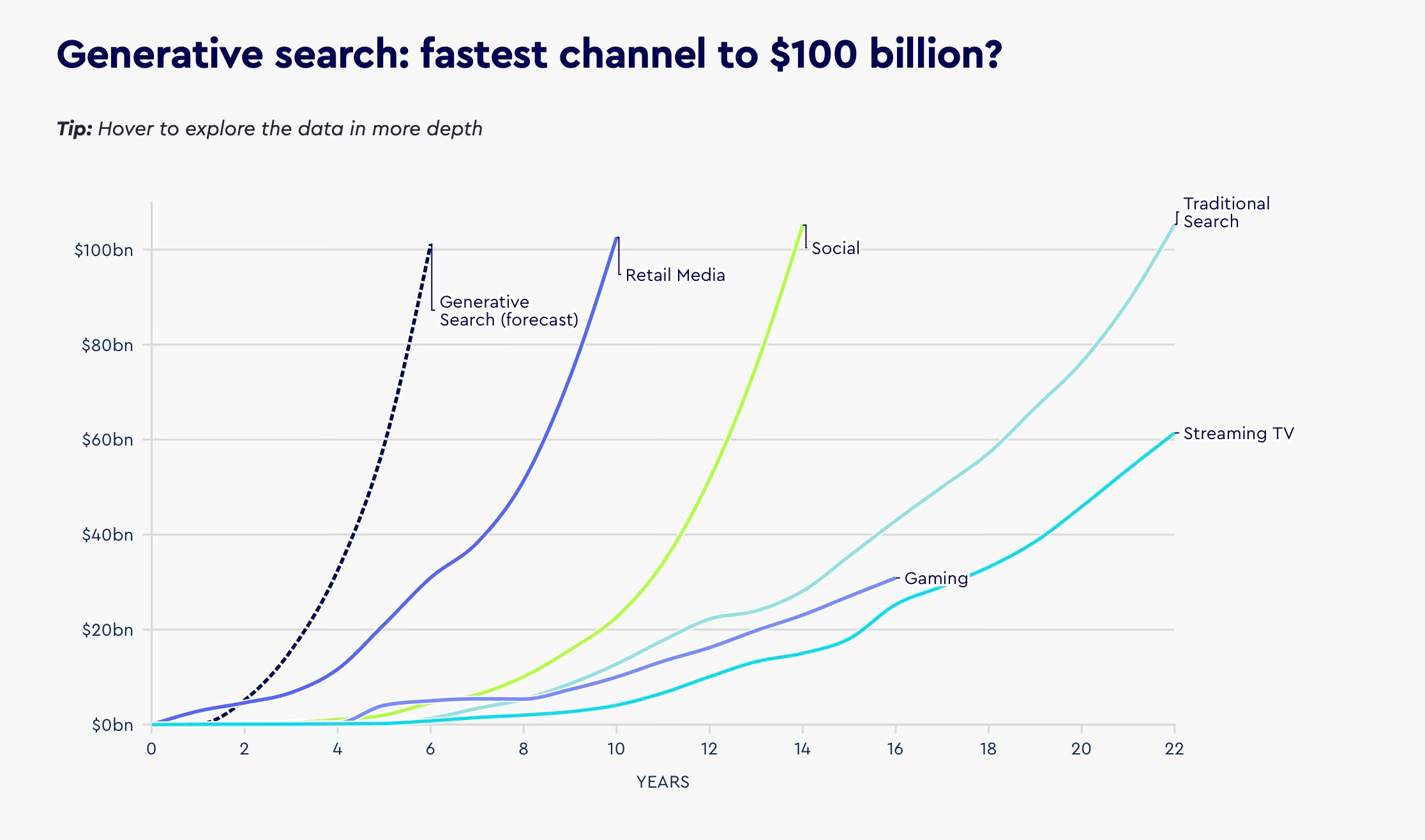
Generative search is a contender to be “the fastest channel to $100 billion” (WPP Media).
Devices and new surfaces
Meta launches the first scaled advertising platform for AI glasses (Forrester).
30% of consumer brand experiences are delivered through ambient smart devices by 2028 (Gartner).
My predictions for 2027 (based on experience & intuition)
1. Early experiments with ChatGPT ads, Google AI Overview ads, and all other sorts of LLM ads
B2B SaaS already buys the biggest share of US ChatGPT ad impressions (19.9% in Graphite and Similarweb; 21.7% of early ads in Seer’s tracking). So the inventory exists but proof of return doesn’t .
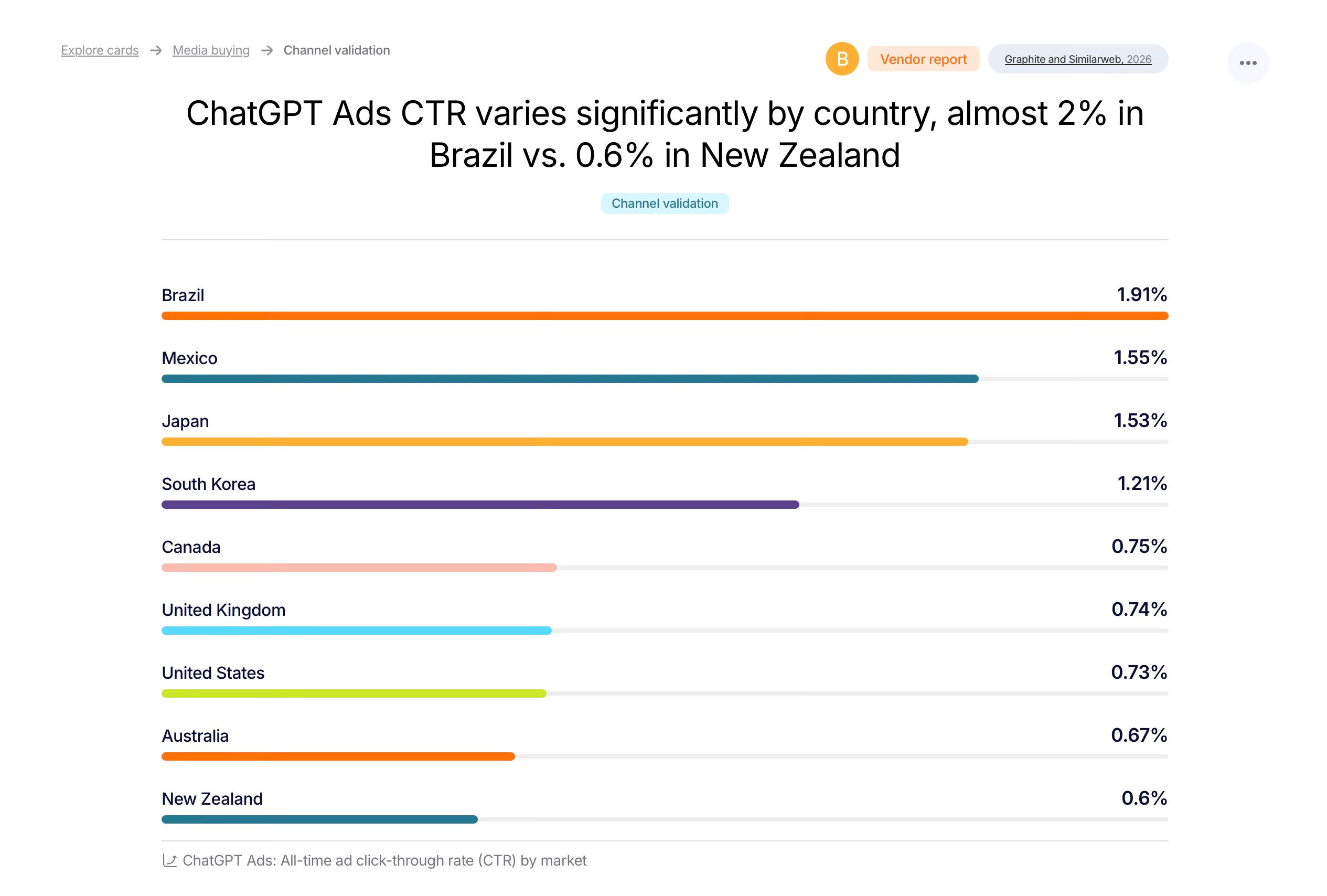
Though we already have the first click data — and it shows how far it has to go.
In the US, ChatGPT ads have an all-time click-through rate of 0.73%, according to Graphite and Similarweb. For comparison, Google search ads averaged 6.42% between April 2023 and March 2024, just before AI Overviews launched in the US (WordStream by LocaliQ, 17,998 US campaigns), and 6.64% in April 2025 – March 2026 (LocaliQ).
TL;DR: assistant ads get clicked about ten times less often than search ads, at least for now.
2. The renaissance of PR and link building
AI search doesn’t answer the question you typed.
It breaks it into a set of sub-questions, searches for each, and builds one answer from what it finds. Google calls this “query fan-out” and its VP of Product for Search describes the system thinking of “a bunch of questions like great restaurants, great bars, things to do if you have kids” (Search Engine Journal).
In other words, the system already has a semantic kernel it’s ideating around, and it’s not really important where you rank for the main queries. Only ~12% of URLs cited by AI assistants rank in Google’s top 10 for the original prompt (Ahrefs).
What wins instead is being mentioned in many places that answer those sub-questions and having your brand as close to the topic as possible.

So the budget for AI visibility that Kantar’s marketers plan to grow (the net 75%) will flow to the old disciplines: PR, earned media, reviews, guest content and link building. My call: in 2027, PR and link building become core AI-optimization channels.
3. Banner blindness reaches creators, and the influencer bubble starts to deflate
People learned to ignore banners, and they’re learning to ignore sponsored posts.
In a Gartner survey of 1,006 US consumers, 35% say they now rely less on influencers for product information because AI-generated content is spreading (Gartner). Ad load matters too: in a Journal of Marketing study of about 5,000 Instagram influencers, sponsored posts did worst for creators with a middling share of ads in their feed, the typical “sometimes sponsored” account.
I think the influencer bubble is starting to deflate into an efficiency zone. Short-term deals don’t have the strongest ROAS, and the return comes from long-term collaboration (there’s a great IPA’s analysis of 220 influencer campaigns to read if you’d love to dive deeper). My call: in 2027, brands cut one-off placements and move budgets to fewer, longer creator partnerships.
4. Customer development and access to power users become a scarce asset
Building a product has never been easier. GitHub saw nearly 1 billion commits and 121 million new repositories in its 2025 reporting year, with commits up 25% year over year (GitHub Octoverse). And more of those products are built by one person: solo founders started 36.3% of new US startups in the first half of 2025, up from 23.7% in 2019 (Carta).

Making a product is easy; building distribution is hard.
A solo founder can change the product in a day but has little budget and no room for a wasted quarter. So the cheapest way to grow is to get the right early users in, talk to them and fix the product fast.
My call: demand for customer development, and for access to power users across categories (communities, panels, research networks), grows sharply in 2027.
5. Founder-led and team-led growth move to the front.
Buyers want proof from people, not brands. In Optimizely’s UK survey, 72% of consumers say they’re more likely to engage with content that feels human rather than automated (Optimizely). So I see the media presence of companies shifting to people who don’t sell anything directly and simply talk about the products they build: founders first, then the team.

That changes careers, too.
A strong X, Instagram or Substack account becomes part of a professional’s value, an asset that raises salary and that companies will pay extra for.
6. Anti-AI content becomes a positioning
The backlash is already measurable. Over a third of web pages published since ChatGPT’s release show signs of AI authorship (Pew Research Center), and audiences are noticing:
50% of US consumers would rather give their business to brands that don’t use GenAI in consumer-facing messages, ads and content (Gartner, 1,539 US consumers, October 2025; Gartner via CMSWire).
57% say the spread of AI content has reduced their trust in brand messages (the same Gartner survey of 1,006 US consumers, September 2026).
62% of UK consumers trust marketing content less since brands started using AI, and 67% find AI-generated images of people in ads creepy (Optimizely, 1,000 UK consumers, September 2026).
Labels change perception on their own: in a Bynder experiment with 2,000 UK and US consumers, more people preferred the AI-written article when it was unlabeled, but 52% felt less engaged once told it was AI-made (MarTech).
My call: “made by humans” becomes a visible positioning in 2027, with brands labeling human-made work the way they label organic food.
7. In-app partnership ads grow, guerrilla-style
When thousands of small products compete for the same users, swapping audiences is cheaper than buying them. Growing companies start offering each other’s products inside their own: as a perk, a bundle or a recommendation.
The early versions are already here. Lenny’s Newsletter Product Pass gives paid subscribers a free year of more than 20 products (Lovable, n8n, Supabase, Gamma and others), with a stated value of over $25,000, so partners trade a free year for access to a product-minded audience. At a larger scale, Airtel offered all of its 360 million customers a free year of Perplexity Pro through the Airtel Thanks app (Bharti Airtel).
My call: with the rise of solo founders, in-app partner placements become a common growth channel for small products in 2027.
Sources
Forecasts:
Forrester, Predictions 2027: B2C marketing, CX and digital — Forrester, Oct 2026. Analyst judgment plus Forrester’s CMO pulse survey; full reports client-only.
Forrester, Predictions 2027: B2B marketing and buying — Forrester, Oct 2026. Analyst judgment plus Forrester surveys; no sample sizes given.
Forrester, Predictions 2027: Big media growth engines hit the limit and pivot — Forrester, Sep 2026. Analyst judgment; three of five predictions public.
Gartner, CMO brand budgets and influence — Gartner, Feb 2026. Analyst prediction plus a survey of 426 senior marketing leaders.
Gartner, agentic AI and influencer budgets — Gartner, Jan 2026. Analyst prediction plus a survey of 335 US consumers.
Gartner, the CMO AI blind spot — Gartner, Feb 2026. Survey of 402 senior marketing leaders.
Kantar, Media Reactions 2026 — Kantar, Oct 2026. Survey of 800 senior marketers and 23,000+ consumers in 33 markets; stated intentions.
WPP Media, This Year Next Year, midyear 2026 — WPP Media, Jun 2026. Forecast model; full detail client-only.
WARC, retail media forecast — WARC via Bizcommunity, Aug 2026. Forecast model.
WARC, linear TV forecast — WARC via MediaPost. Forecast model.
eMarketer, CTV and linear TV — eMarketer, 2026. US forecast model.
Studies from the Stacy’s Brain library (graded, reviewed manually):
Nielsen, 2026 Annual Marketing Report — Nielsen, Oct 2026. Survey of marketers in six countries; self-reported. Two chapters used.
IAB, 2026 Outlook Study: September update — IAB, Sep 2026. 211 US ad buyers, July 2026; stated plans.
The CMO Survey 2026 — Duke Fuqua, Deloitte and AMA, 2026. US marketing leaders, January 2026; self-reported.
McKinsey, AI-first marketing capabilities — McKinsey, Jun 2026. Several McKinsey surveys, including 521 marketers in March 2026; self-reported.
CMI and MarketingProfs, B2B content and marketing trends for 2027 — CMI and MarketingProfs, 2026. B2B marketer survey; self-reported.
AirOps, GEO strategy playbook — AirOps, Jul 2026. AirOps’ own citation research; observed.
Graphite and Similarweb, State of ChatGPT Ads — Graphite and Similarweb, 2026. 95,000+ US ads from 500+ advertisers plus panel data; observed.
Seer Interactive, Early observations on ChatGPT ads — Seer, Jul 2026. 97 client workspaces, ~2 weeks of tracking; observed.
Lily Ray, Predicting the next big Google update — Lily Ray, 2026. Practitioner tracking of AI Overview citations; observed, method not formal.
LocaliQ, Search Advertising Benchmarks 2026 — LocaliQ, Jul 2026. 13,474 US search campaigns, Apr 2025–Mar 2026; observed; vendor data.
Ahrefs, Only 12% of AI-cited URLs rank in Google’s top 10 — Ahrefs, Aug 2025. AI assistant citations vs Google and Bing results; observed.
Pew Research Center, How much of the internet is written with AI? — Pew, Aug 2026. Sample of English-language web pages, July 2026; modelled detection.
Li et al., Endorsement rate in influencer marketing — Journal of Marketing, 2026. ~5,000 Instagram influencers plus experiments; peer-reviewed.
IPA, Beyond Engagement: influencer marketing payback — IPA, Oct 2025. Marketing mix models of 220 influencer campaigns from 144 brands.
Outside our library:
Visionary Marketing, AI tool spend benchmark 2026 — agency research, Apr 2026. 2,400 marketers via Pollfish plus 240 account audits; not graded by us.
Gartner, CMO Spend Survey 2026 — via Marketing Dive, May 2026. 401 CMOs, Jan–Mar 2026.
Walmart and Pactum supplier negotiations — Talking Logistics, May 2023, citing Harvard Business Review. Pilot with 100 tail-end suppliers.
Ahold Delhaize USA and Pactum — CPO Strategy, Jul 2026. Early pilot; no results published.
Migros automatic replenishment — invent.ai, 2025. Vendor case study; results self-reported.
Amazon Business AI tools — Amazon press release, Nov 2025.
WordStream by LocaliQ, Google Ads benchmarks 2024 — WordStream, 2024. 17,998 US search campaigns, Apr 2023–Mar 2024; vendor data.
Query fan-out in Google’s AI Mode — Search Engine Journal, Jul 2025. Interview with Google’s VP of Product for Search.
Gartner, consumers rely less on influencers due to AI — Gartner, Sep 2026. Survey of 1,006 US consumers; self-reported.
Gartner, consumers prefer brands that avoid GenAI — Gartner via CMSWire, Mar 2026. 1,539 US consumers, Oct 2025; self-reported.
Optimizely, AI and trust in marketing — Optimizely, Sep 2026. 1,000 UK consumers and 100 marketers; self-reported; vendor survey.
Bynder experiment on AI-labeled content — via MarTech. 2,000 UK and US consumers; fieldwork date not given.
GitHub Octoverse 2025 — GitHub, Oct 2025. Platform data, Sep 2024–Aug 2025.
Carta, Solo Founders Report 2025 — Carta and Solo Founders, Dec 2025. Carta data on US startups.
Lenny’s Newsletter Product Pass — offer page; no partner results published.
Airtel and Perplexity partnership — Bharti Airtel press release, Jul 2025.
Stacy’s Brain reads marketing research so you don’t have to, grades every source for methodology, sample and vendor interest, and tells you how far to trust each number.