

Every month, Green Dots gets 10–15 leads with the same request: “We want creators to promote us, and we want to pay them per result.”
Meanwhile, creators with 15–30K followers get affiliate invites almost every day. Most of them don’t reply. The ones who do usually say the same thing: “Let’s talk about a fixed fee, or at least a hybrid deal.” And then the project either walks away or offers a fee so low it isn’t worth the creator’s time.
So bringing creators into an affiliate program has become one of the biggest pains in affiliate marketing. In this article I’ll go through why it happens, what creators actually think about these offers, and what we do at Green Dots when a client comes to us with an affiliate brief (something you can steal).
TL;DR
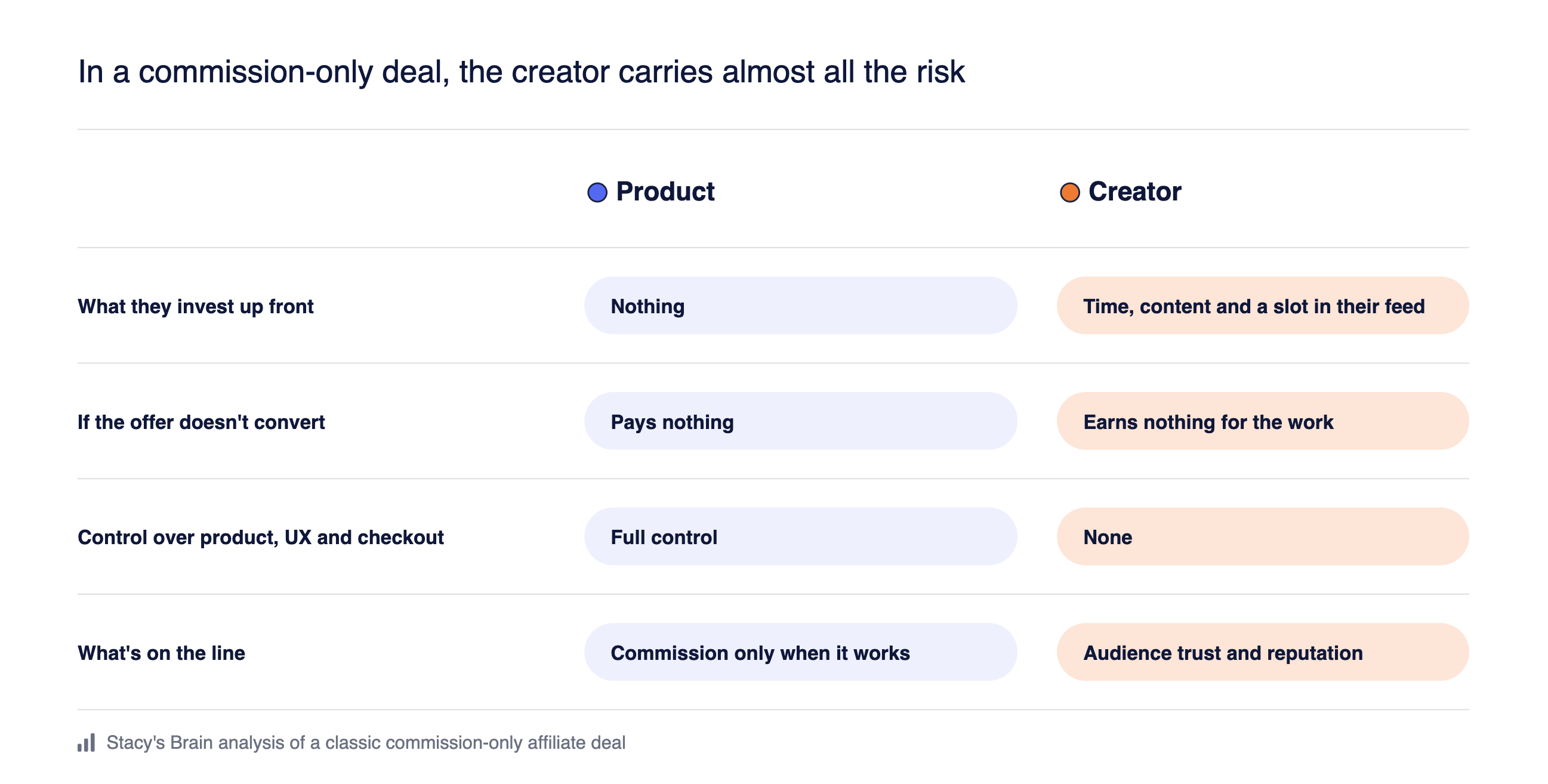
Classic affiliate puts all the risk on the creator. The product pays only for results; the creator pays with time, content and audience trust.
Most affiliates never sell. In Rewardful’s data on 2,847 SaaS programs, only 1.28% of affiliates generate even one sale.
Creators aren’t happy with affiliate income. Only 24% are satisfied with what affiliate deals earn them (CreatorIQ and Ipsos).
Affiliate is a big-brand game, like paid ads. Known brands offer status, access and payouts that a new product can’t match.
New products should start with hybrid deals: a fixed fee plus commission, so the risk is shared.
Check the math first. If the cost per user a creator expects is higher than your LTV, affiliate isn’t your channel yet.
Field note: Performance-based deals can work well — and, as an agency, we also take on engagements where our compensation depends on referral results. But before committing, we test the market and assess the offer’s strength. A low acceptance rate → complexity and hidden costs may outweigh the LTV.
Why creators say no
The risk sits on one side of the table
Affiliate is a very attractive model for a business. The product risks almost nothing: it gets a creator on board and pays only if the creator brings real results.

Now look at it from the creator’s side. By promoting you, the creator becomes a kind of co-author of your product, without any say in its quality, its UX or how easy it is to finish a purchase. If your onboarding breaks or your checkout is clunky, the creator loses the commission and you lose nothing. And rev share and affiliate rewards are rarely generous enough to justify that risk.
Who carries the risk in a classic commission-only affiliate deal: the product and the creator compared.
There’s one more thing that’s easy to miss. If a product is genuinely great and a creator sees potential in it, they’ll find your referral link themselves. They’ll join the program on their own, or reach out and negotiate terms that work for them.
So classic affiliate is weak specifically as an outreach channel. When you have to chase creators with a commission-only offer, that’s usually a signal in itself. And in practice, this ends in disappointment. A team spends weeks polishing an offer, pays an affiliate manager $3–6K a month, and gets a handful of applications.
What creators and affiliates actually think
The numbers back this up:
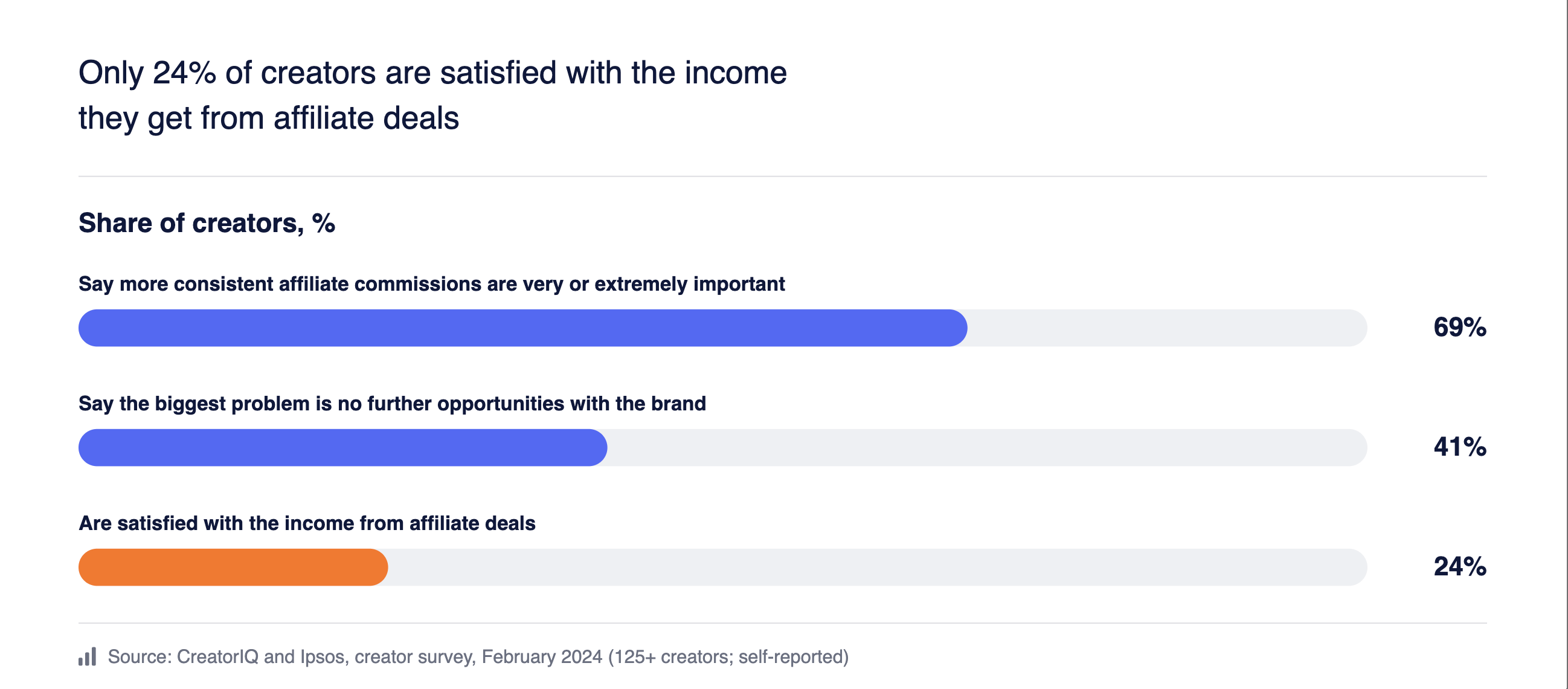
Creators’ views on affiliate deals, % of creators. Source: CreatorIQ and Ipsos, February 2024, 125+ creators.
Only 24% of creators are satisfied with the income they get from affiliate deals, and 41% say the biggest problem with affiliate programs is that the brand offers nothing beyond the link (CreatorIQ and Ipsos, 125+ creators).
In a Modash poll of 57 creators, about a third had stopped accepting affiliate commissions altogether, because commissions alone weren’t enough (Modash).
When asked what would make brand partnerships work better, 40% of creators name fairer pay and 41% name consistent, long-term collaboration (CreatorIQ).
And most people who join programs never sell anything: only 1.28% of affiliates in Rewardful’s dataset of 2,847 SaaS programs made at least one sale (Rewardful, vendor data).
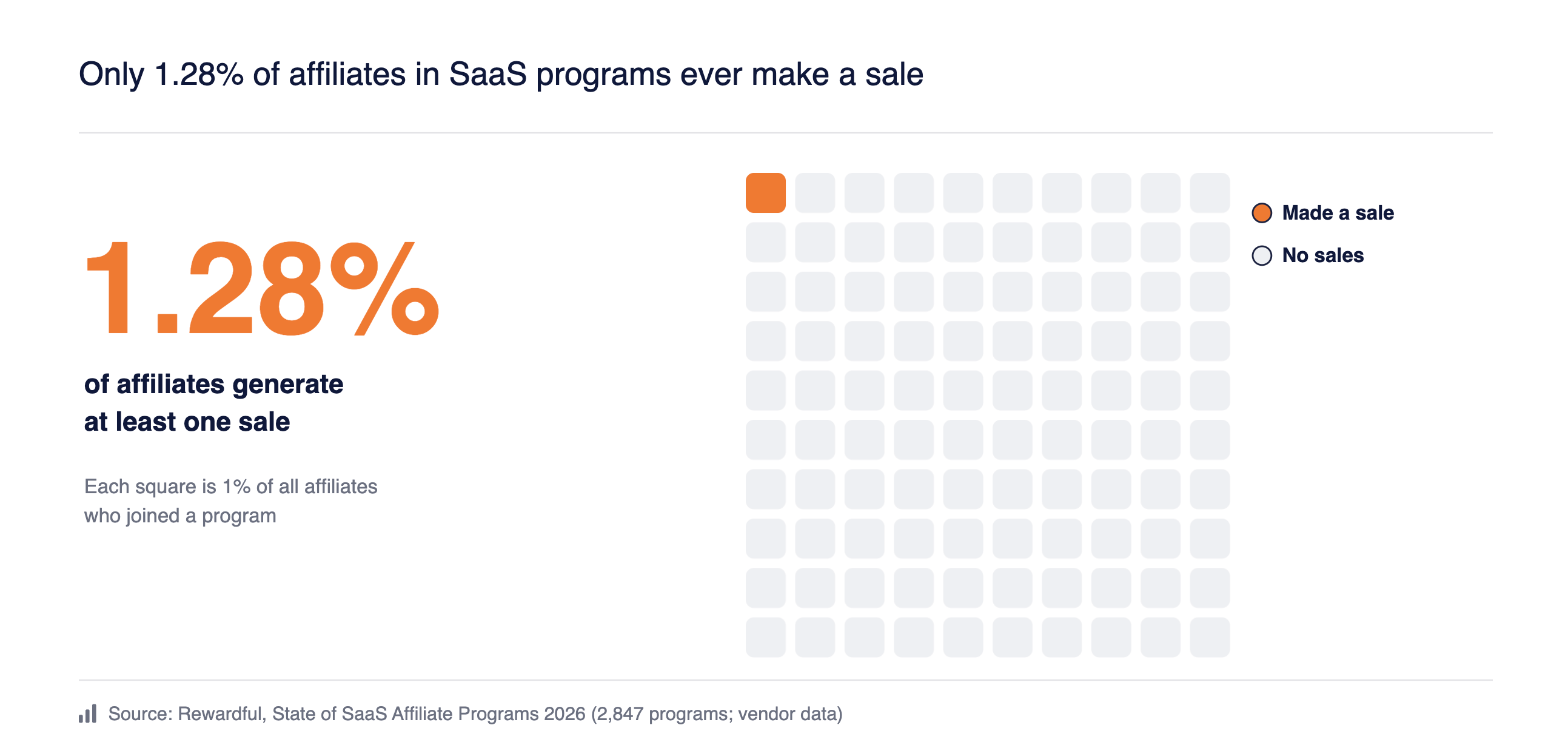
Share of affiliates in SaaS programs who generated at least one sale. Source: Rewardful, State of SaaS Affiliate Programs 2026, 2,847 programs (vendor data).
Reddit threads from founders who tried affiliate marketing are a good illustration as well.
A supplement brand reached out to about 200 influencers with what it considered a generous offer ($15 per order and $8 a month for every subscriber) and got one “yes”, who then went silent. A small SaaS offered 40% recurring commission for life and got zero takers. The replies from practitioners explain why:
“Why would they be your salespeople without cash up front?” An unknown brand, an unknown tracking tool and no upfront payment read as all risk and no reward. Several creators in the threads say they simply ignore 99% of these emails.
Creators won’t recommend what they haven’t used. In risky categories they also worry about their audience’s trust.
Good creators are already taken. Bigger creators are often under exclusive contracts; mid-size ones get a fee plus commission. Commission-only offers end up reaching the smallest accounts.
Attribution breaks. People see a creator’s video, then buy later through search or the app store, and the sale never touches the link. As one practitioner put it: you don’t do affiliate deals with influencers, you do retainers.
“Recurring times no traffic is still no traffic.” One Redditor explained that the first number they check isn’t the commission rate but how many hours of work sit between them and the first dollar. A high rate doesn’t help if the content won’t rank or get seen.
Selling your audience is the real cost
There’s a cost creators feel and brands rarely see: every recommendation spends audience trust. If the product is weak, or the creator doesn’t actually use it, the creator earns nothing and loses something. Some followers unsubscribe, others decide the creator has “sold out”.
Audiences are already skeptical. Only 5% of US consumers trust influencer advertising completely, and 26% don’t trust it at all (BBB National Programs). Among creators themselves, only 15% fully trust sponsored content from other creators (CreatorIQ State of Creators via Tubefilter, 5,095 creators). So a creator saying “no” to a commission-only offer from an unknown product is protecting their main asset.
The market is big, but it isn’t yours yet
At the same time, affiliate is a huge market.
US affiliate spend is forecast at $13.8 billion in 2026, up 11% year over year, and creators are the fastest-growing type of affiliate publisher (eMarketer). Many large brands grow through affiliate funnels, and the channel is often sold to founders as one of the best options for any business.
But it’s the same trap as paid ads. Big, established brands simply play a different game.
In the 2026 State of B2B GTM survey of 300 B2B software and AI companies, small companies most often put their network and intros in their top 3 channels (54% under $1M ARR, 46% at $1–10M), along with cold outreach and LinkedIn posting. Paid ads only reach the top of the list above $50M ARR, where 43% rank them in their top 3, more than any other channel. Ad-platform data in the same report puts the median monthly ad spend of those companies at $63,000, against $5,400 at $1–10M ARR. It’s B2B software and mostly self-reported, but the pattern is familiar: channels that run on money and reputation work for those who already have both.
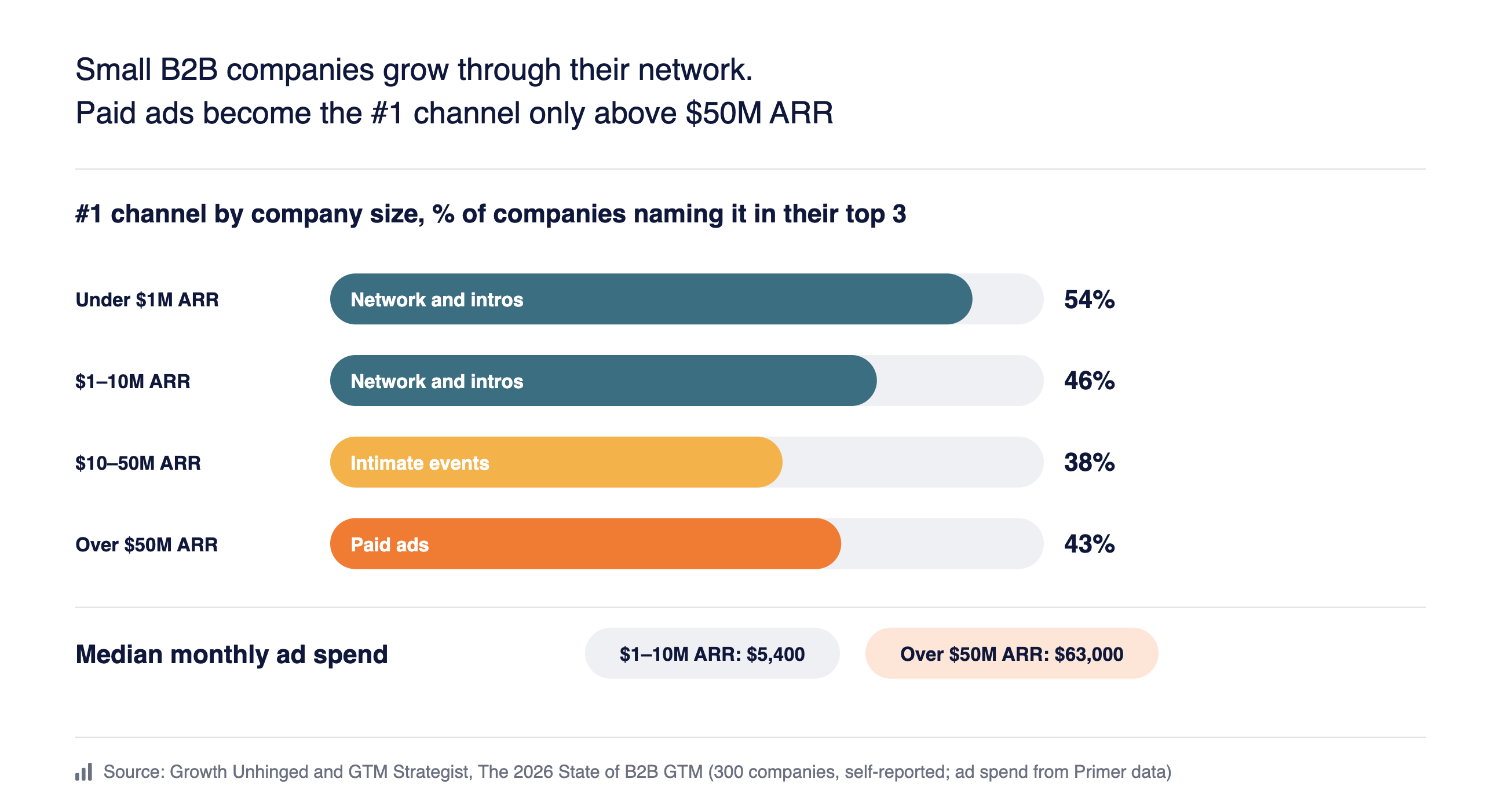
The channel B2B software and AI companies most often rank in their top 3, by company size (ARR), and median monthly ad spend. Source: The 2026 State of B2B GTM, 300 companies; ad spend from Primer data.
Affiliate works the same way.
A big brand can offer creators things a new product can’t: unique access, status, special terms, a name that converts on sight. For a small product, you first have to earn your place in the sun, so that a creator is willing to spend time on you, make content about you and mention you without risking their audience.
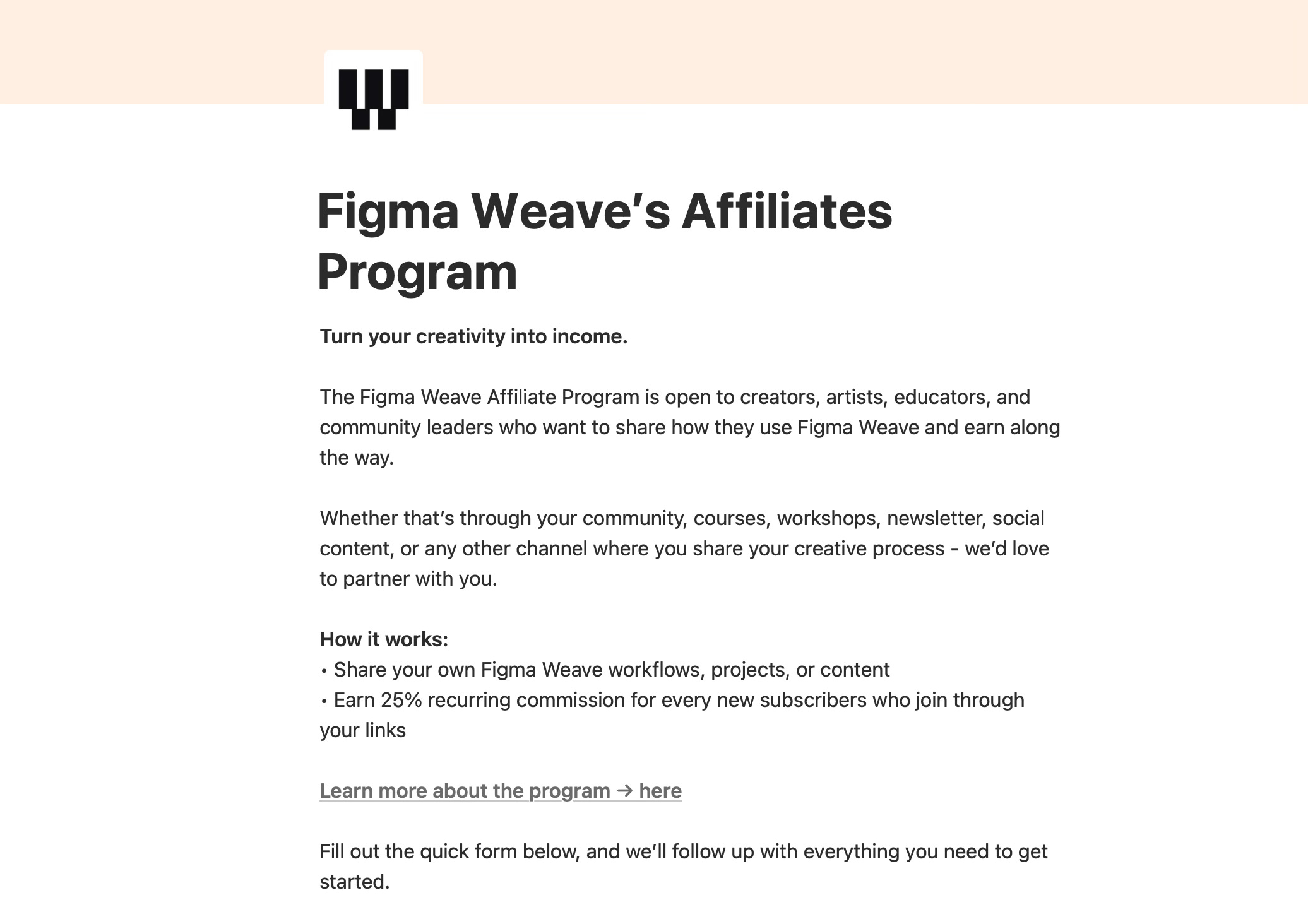
A simple example. You’re a designer using Figma. You have your own blog. Why would you promote a Figma competitor if your favorite app is paying you 25%?
Or another one – from fintech. Say a new crypto card or neobank wants creators to bring users at $5–10 per sign-up. A creator who has promoted fintech before knows how these products convert and roughly what they can earn. And in the same market there’s Revolut, which runs a public affiliate program through Impact and pays £50 for every referred customer who passes KYC and tops up their account. All while also giving new customers a £20 cashback through partner links (Revolut).
Choosing between Revolut and an unknown card at $5 a user isn’t a hard decision.
When affiliate does work
To be fair, affiliate isn’t broken for everyone. We ran a creator campaign for a large neobank with a total budget of $15,000, including the agency fee, and brought in around 800 users who registered and passed KYC. That’s roughly $19 per verified user, all costs included, which was a very reasonable price for this kind of product.
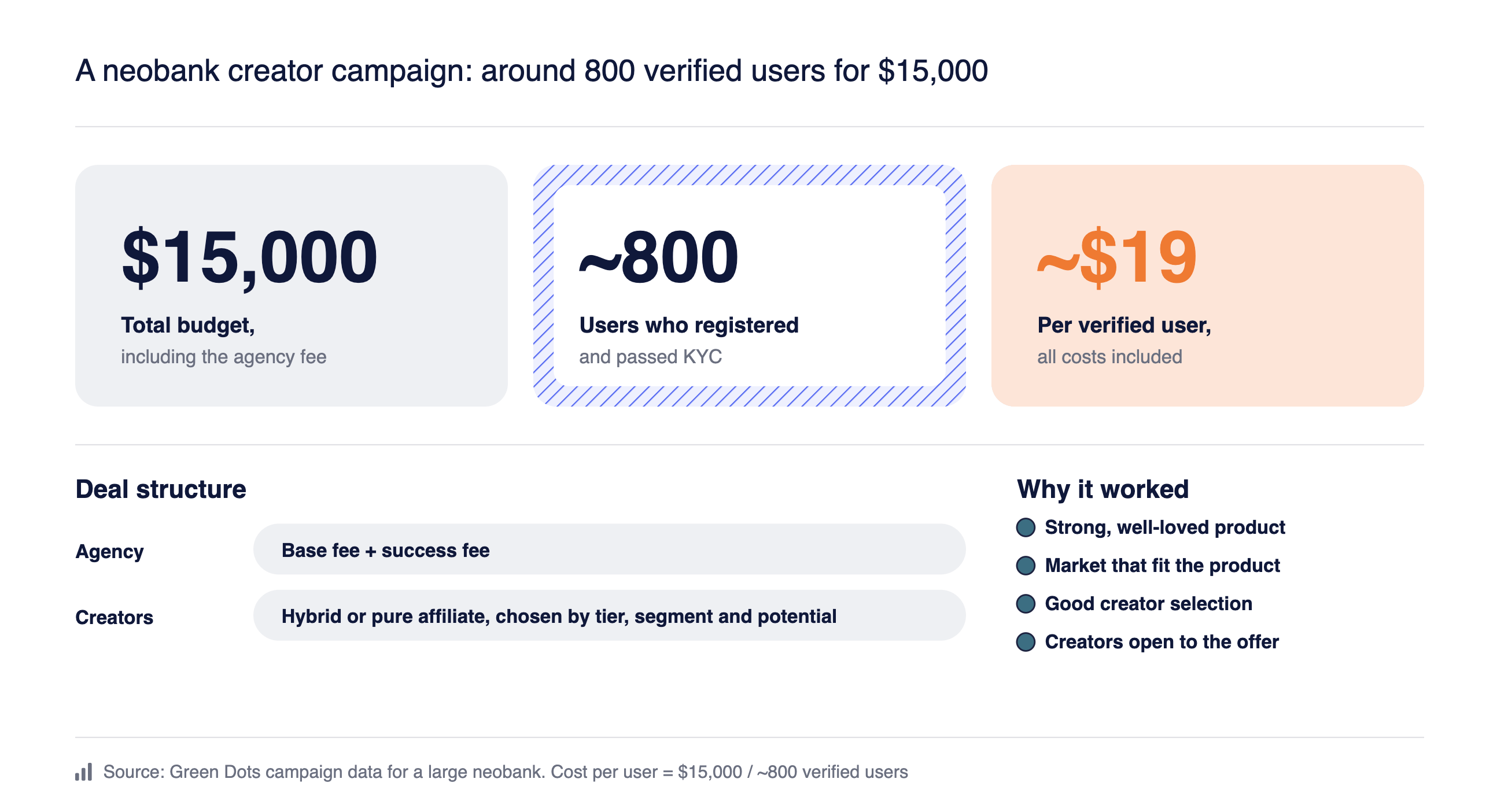
Key numbers from a Green Dots creator campaign for a large neobank: budget, verified users and cost per user.
It worked because everything lined up: a strong, well-loved product, a market that fit it, a good selection of creators, and many of those creators were open to the offer from the start. The agency worked on a base fee plus a success fee. For creators, we pitched both hybrid and pure affiliate deals, choosing for each one based on their tier, their audience segment and how promising they looked for the product.
And as far as I know, many of the affiliates we onboarded during that sprint are still with the product and keep bringing in users.
So it’s wrong to say affiliate doesn’t work. It works, but you have to be somebody for it to work.
Field notes: What we do at Green Dots when we need to onboard creators for affiliate deals
I’ll be honest: I hate it when clients come to us with an affiliate program they want us to promote. These are some of the most challenging deals, so we’re very selective.
It’s always hard to explain to a founder that their affiliate program isn’t competitive enough. That’s why we offer teams a month-long fieldwork pilot to show them the actual acceptance rates of their offers.
Below is a practical workflow. This isn’t a sales pitch — feel free to use it in your own company.
Step 1. Audit the offer
When a client comes to us with an affiliate brief, we start with the offer itself, based on our experience with similar products and market context. We look at how strong the product and the proposal are, and whether the payout is in the market.
Creators know very well what a user costs for different types of products through other channels, so an offer below that level gets ignored no matter how polished the deck is.
If the product is new, we usually propose a hybrid deal: a fixed fee plus commission. Convincing a creator to promote a new product for free is close to impossible.
The risk has to be shared between the creator and the product.
Step 2. Run a one-month pilot
In the first month we run a pilot. We shortlist 35–40 creators for the client, agree the list with them, and pitch. These are warm, close contacts of the agency, so we get honest answers and real feedback on the program.
This step matters because clients often assume the agency just wants more money or isn’t trying hard enough. In reality, the gap is usually in expectations: how competitive the offer is, and how well the affiliate channel can work for this product at all. The pilot is basically field customer development. We find out whether the “customers” of your affiliate program, the creators, are ready to take part.
Step 3. Decide based on the signal
After the pilot, there are three possible outcomes:
The offer resonates. If creators respond, we move to a retainer that covers the agency’s team costs, plus a success fee, so the agency also depends on results.
The signal is weak, but fixable. We suggest a full customer development sprint: improve the product until it’s interesting to creators, and rebuild the affiliate program together with creators, involving them in the process.
Expectations and reality don’t meet. Then we part ways. A gap between what a client expects and what the market can give is very common. Either we can show evidence and grow the product on it, or we go our separate ways.
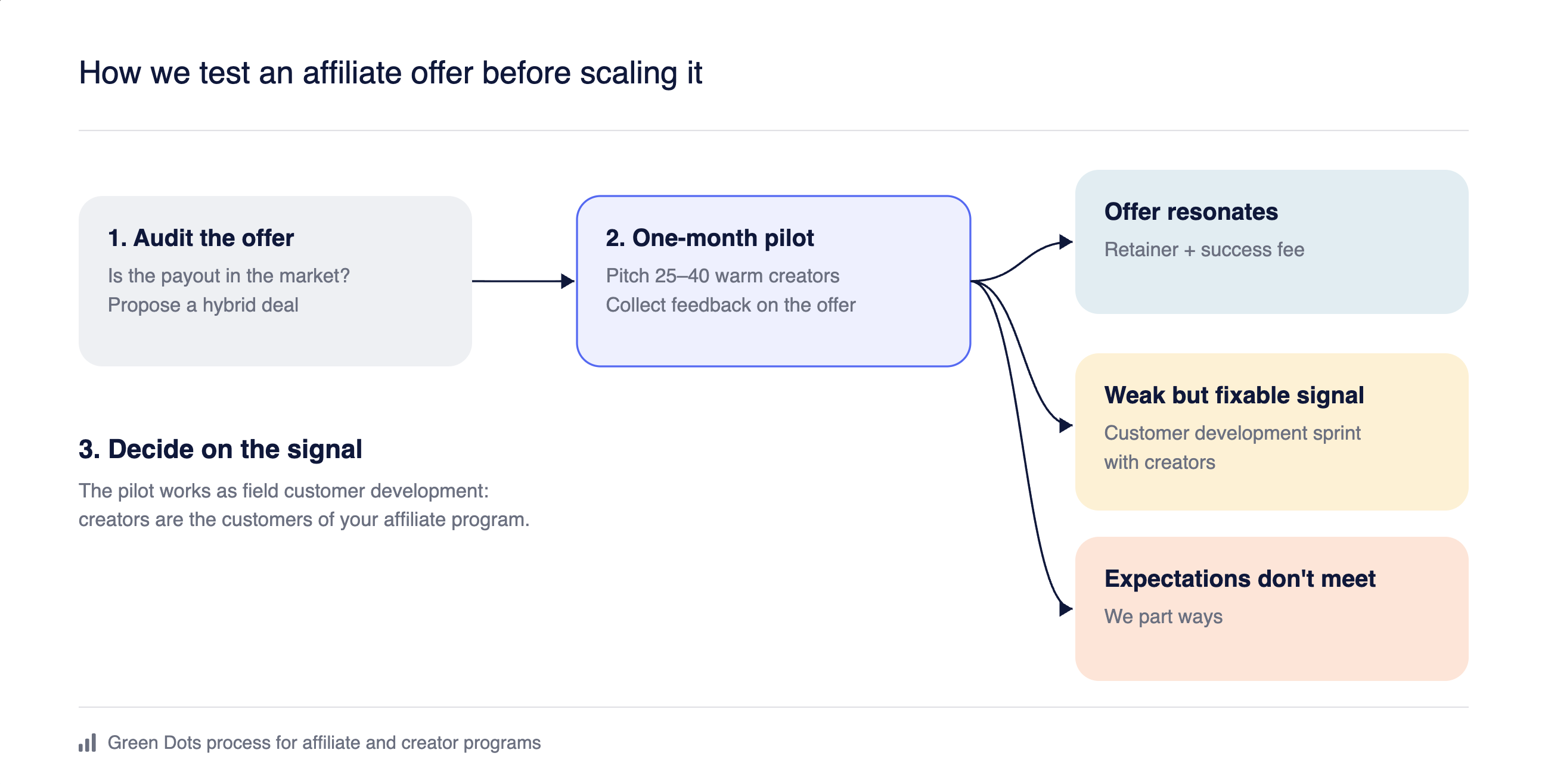
A good pilot doesn’t just tell you whether creators will join. It tells you what they’d need to join: a different payout, a different format, a better product, or a different channel altogether.
Practices that help
Beyond the pilot, a few tactics work much better than cold “join our program” emails. Most of them come up again and again in practitioner threads:
Ask for a spot on lists that already exist. Find people who already have affiliate partnerships with other brands, or who publish “best tools for X” and “X alternatives” pages that rank. Ask them to add your product. You’re not asking anyone to build something new: the page exists and already gets traffic. One publisher suggested sending the author the row already filled in: price, what you do better, what you do worse, a screenshot and a test account.
Go after creators’ evergreen assets, not new posts. Creators who already earn through rev share often have evergreen Substack articles, pinned posts with product recommendations or resource pages that keep getting traffic. Asking to be added there is a much smaller ask than a dedicated video.
Start with people who already mention you. If a creator has mentioned your product organically, offer them an affiliate link so they can monetize what they’re already doing. Your existing happy customers are the same story.
Sell conversion data, not the rate. Experienced affiliates care more about “of the last 100 trials, this many converted and stayed this long” than about 20% versus 30%. Put the commission, the attribution window and your conversion numbers in the first message.
Choose fit over size. Better audience–brand fit was associated with 1.95x higher odds of conversion in niche influencer campaigns (Journal of Marketing & Social Research), and across 63 niche campaigns nano creators (1–10K) had the highest conversion rate and the lowest cost per acquisition (Stacy’s Brain collection).
My take: start hybrid, and check the math
If you’re a new product, start with hybrid deals. Find the zone where creator payouts work for your business, and build from there.
And be honest with yourself about unit economics.
If you’re a small, early product, there’s a real chance the math won’t work even with affiliate: the price per user a creator is ready to accept may be higher than your user’s LTV. Then affiliate isn’t your channel yet.
In that case, I’d invest more in organic growth: viral content, short-form formats like Instagram Reels, and owned media. It takes longer, it’s harder and there are fewer guarantees. But at least the math adds up, and you won’t spend money on an in-house affiliate manager or burn your team’s time trying to get from the market something it can’t give you right now.
Sources
Studies from the Stacy’s Brain library (graded):
CreatorIQ, State of Creator Marketing — CreatorIQ creator survey; self-reported; vendor research.
BBB National Programs, consumer trust in influencer advertising — US consumer survey, 2025; self-reported.
Journal of Marketing & Social Research, influencer marketing in niche markets — 2025 study of niche creator campaigns; association, not causation.
Increasing creator marketing efficiency in 2027 — Stacy’s Brain collection.
Outside our library:
CreatorIQ and Ipsos, affiliate engagements are not enough for creators — Feb 2024, 125+ creators; vendor press release.
Modash, creator affiliate survey — Oct 2026, 57 creators and 70 marketers; small sample.
Rewardful, State of SaaS affiliate programs — Mar 2026, 2,847 programs; vendor data.
CreatorIQ State of Creators, via Tubefilter — Aug 2026, 5,095 creators; self-reported.
Growth Unhinged and GTM Strategist, The 2026 State of B2B GTM — Oct 2026, survey of 300 B2B software and AI companies plus Primer ad-platform data on 379 advertisers; self-reported; sponsored by GTM tool vendors.
eMarketer, affiliate marketing in 2026 — US forecast.
Revolut affiliate programme — program terms page.
Reddit threads in r/marketing, r/shopify, r/AffiliateMarket, r/Affiliatemarketing, r/SaaSMarketing, r/SaaSSolopreneurs, r/GrowthHacking — practitioner opinions, quoted as examples.
Stacy’s Brain reads marketing research so you don’t have to, grades every source for methodology, sample and vendor interest, and tells you how far to trust each number.
that 1.28% stat stopped me, it explains why creators ask for a fee first instead of gambling on a link