

AI search optimization is the new black
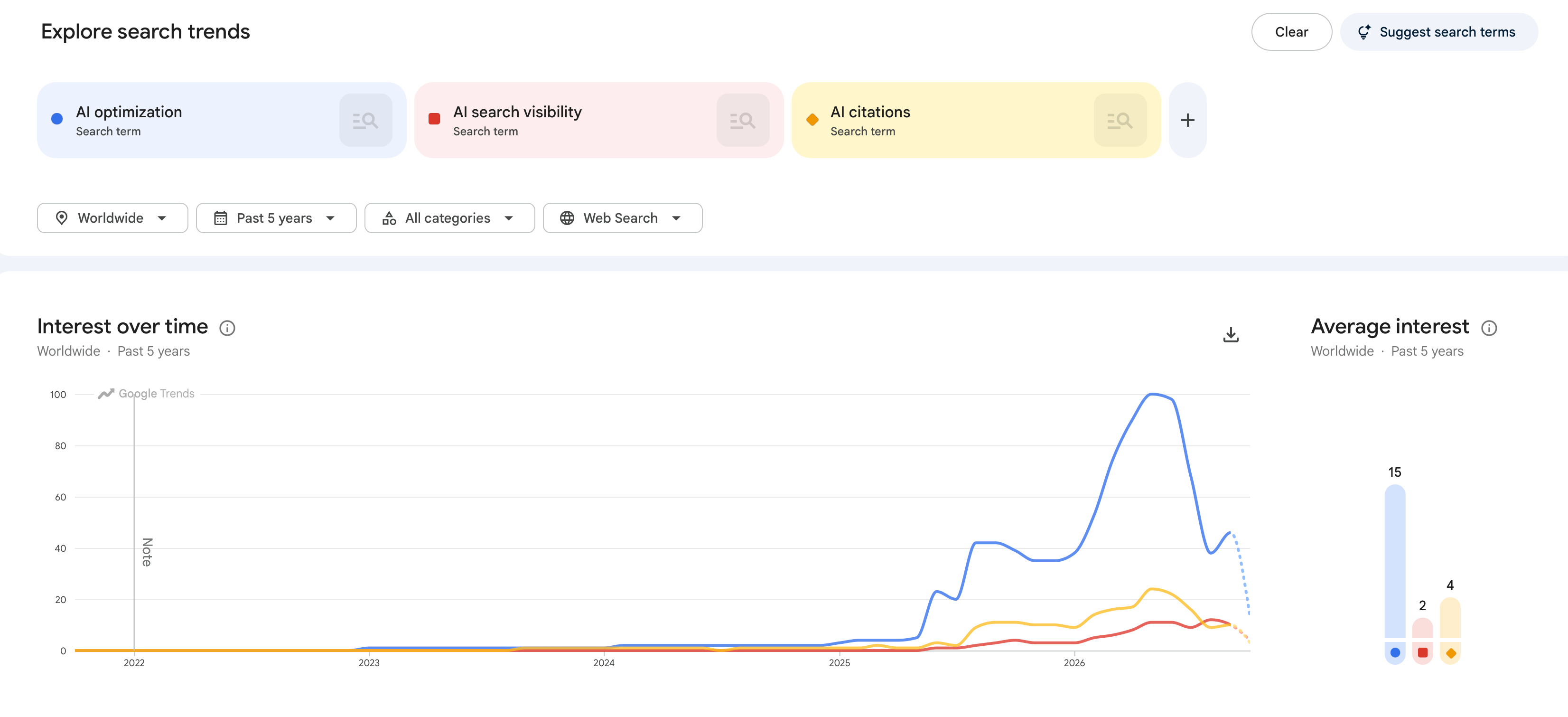
Open any vendor outlook for 2026 and 2027 and the same line runs through all of them: AI answers are becoming a primary discovery surface, and brands need to be visible inside them.
The industry has converged on this, and Google perfectly pictures this trend.
The change in user behavior is real.
In HubSpot’s 2026 marketing survey, 49% of marketers said search traffic to their site has already dropped because of AI answers (source).
In 2025 Google’s AI Overviews appeared on roughly 31% of one tracked keyword set. A year later it is already 48% (source).
So it’s no wonder that 86% of US buy-side ad decision-makers said they are already changing, or plan to change, how they measure performance for the AI web (source). Similarweb, Kantar, and McKinsey have all shifted their main advisory and research focus to how buyer behavior is changing — and what should be done about it.
AI optimization necessity is now the consensus.
The problem sits one layer down though, in the advice.
AI answer systems are being rebuilt faster than anyone can document them
In the space of a few months in 2026, ChatGPT changed how many background searches it runs per question, how it phrases them, how many sources it credits, and how often it goes back for a second round (source).
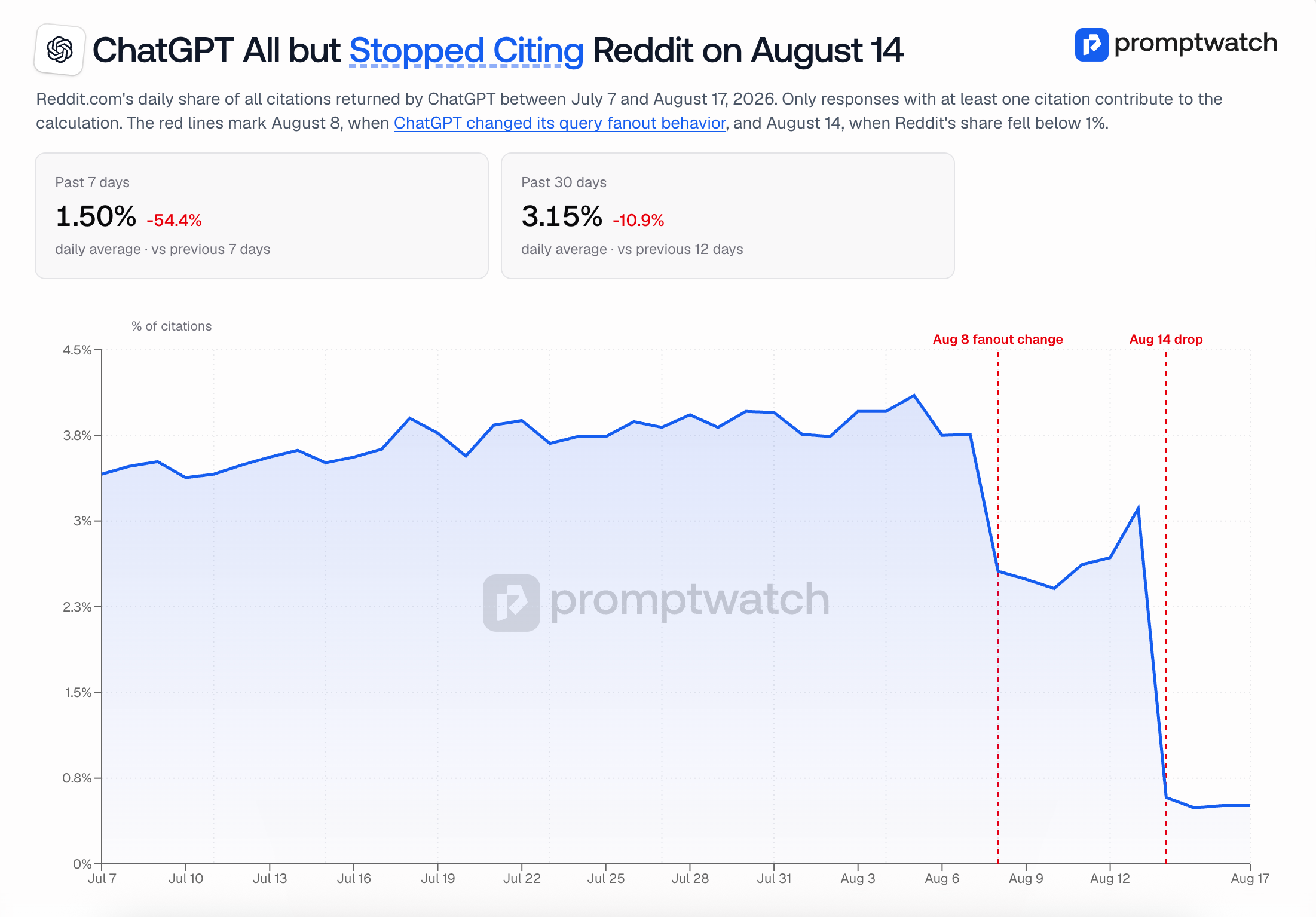
In August 2026 Reddit stopped being the #1 source for community discussions seeding aimed at increasing citations: Reddit’s share in ChatGPT Search fell by 86.4% inside just ten days (source).
Meanwhile, if you search “how to optimize for ChatGPT search” on Google, it still shows Reddit and Quora among the top results — based on a one-year-old article.
Let’s be realistic: a guide written against mid-2025 algorithm is describing a different AI engine.
Furthermore, most of these guides and articles are written by vendors — and if an article from 2024 was cited by AI, they’ll keep updating the publish date to stay relevant in search, creating a contextual trap for both LLMs and humans relying on their output.
This is one of the latest cases I encountered:
We’re building stacysbrain.com to tackle exactly this problem, so you always know what kind of insight your data relies on, how old it is, and whether there’s a vendor interest behind it.
We also maintain a live GEO/AEO collection, updated quarterly:
So what do we have left?
We need to apply filters and re-review what’s currently observable. That’s why we prepared this Q4 2026 snapshot — to give you an accurate picture of the algorithm you’re optimizing for.
LLMs have a shortlist before they search
When you ask ChatGPT a question, it does not pass your words to a search engine. It writes its own background queries first (called fan-out queries) and those queries decide what it will ever see.
The volume of that activity climbed sharply through 2026.
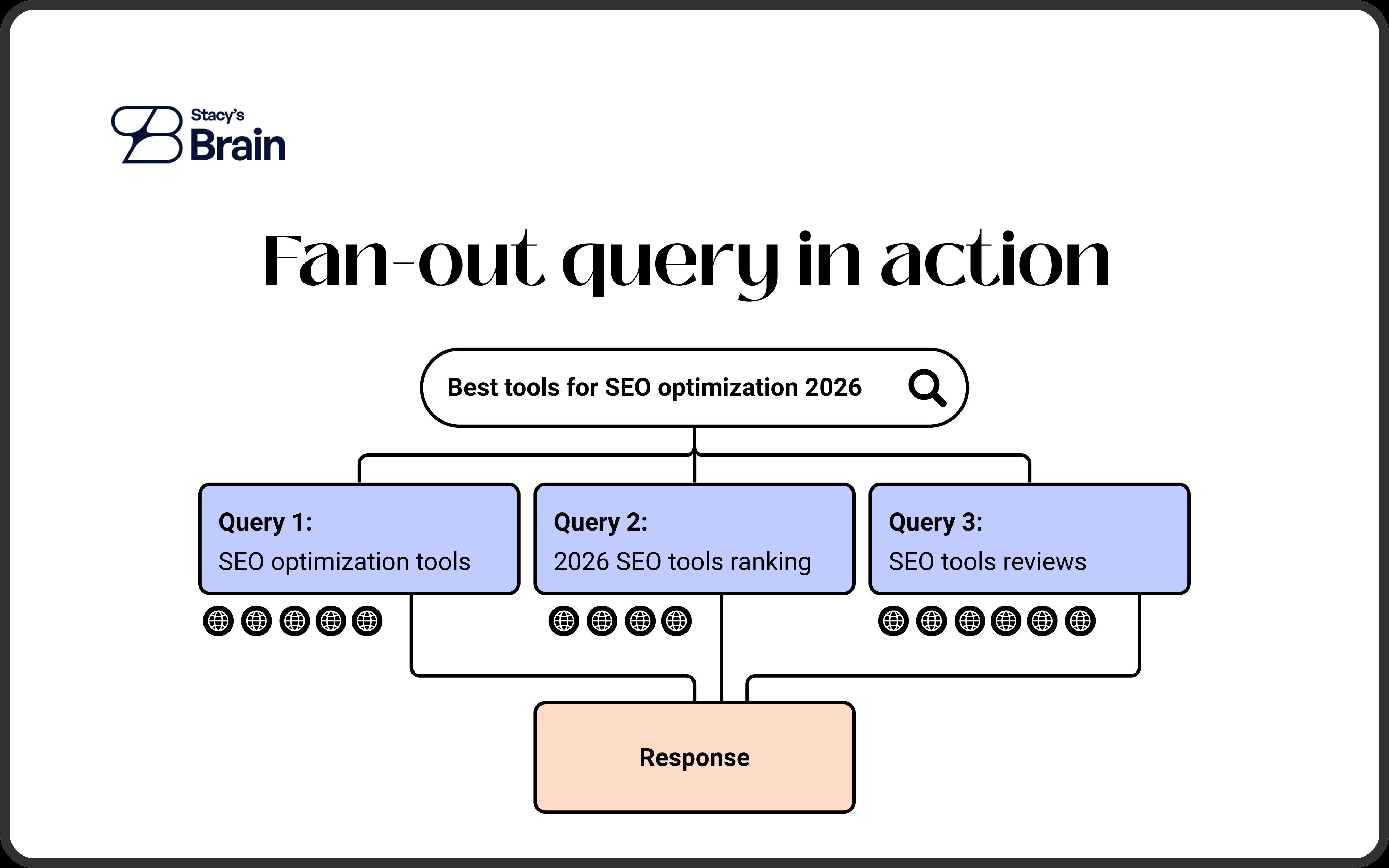
The average number of fan-out queries per prompt reached 7.5, against 2.17 in 2025. The share of prompts where the system goes back for a second round of searching rose from about 5% to 33.5%. At the same time the number of unique domains credited in a finished answer fell from 19 to 15 (source).
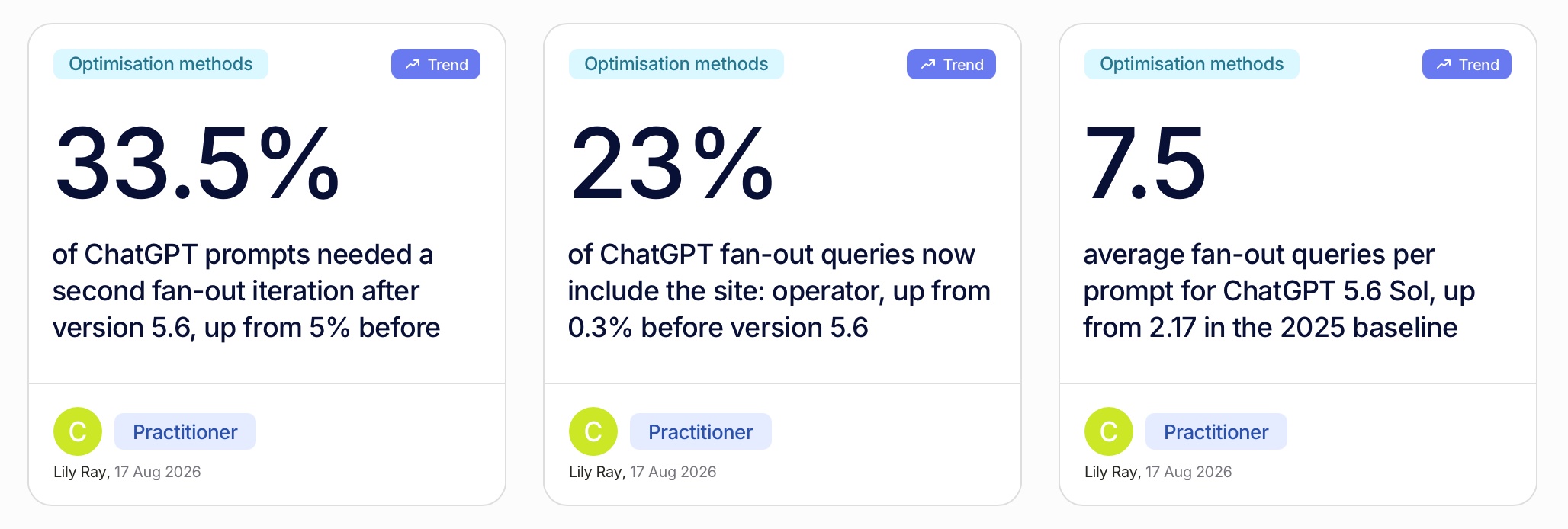
Meaning: The system reads considerably more and cites noticeably fewer.
The shape of those queries also changed.
ChatGPT now uses the site: operator in about 23% of its fan-out searches, up from 0.3%.
Instead of asking the open web who makes good SEO software, it frequently goes straight at a named domain to pull a specific fact — a price, a spec, an integration list. That’s why product pages have risen to 16.39% of all retrieved pages, overtaking listicles as the most-fetched page type (source).
Getting into background AI searches
The most essential question for AI optimization is understanding where the brand names in these queries come from — and the answer is not optimistic.
In testing across thirteen product categories, ChatGPT injected brand names into its own background searches in eleven of them, even though the user never typed those brands (source). This suggests the model first drafts a shortlist based on what it already associates with the category, then goes looking for evidence about the companies on that list.
That ordering appears to matter a great deal.
In one practitioner study, brands that appeared in the initial fan-out query were cited in the final answer roughly 33 times more often than brands that were merely fetched during the search (source).
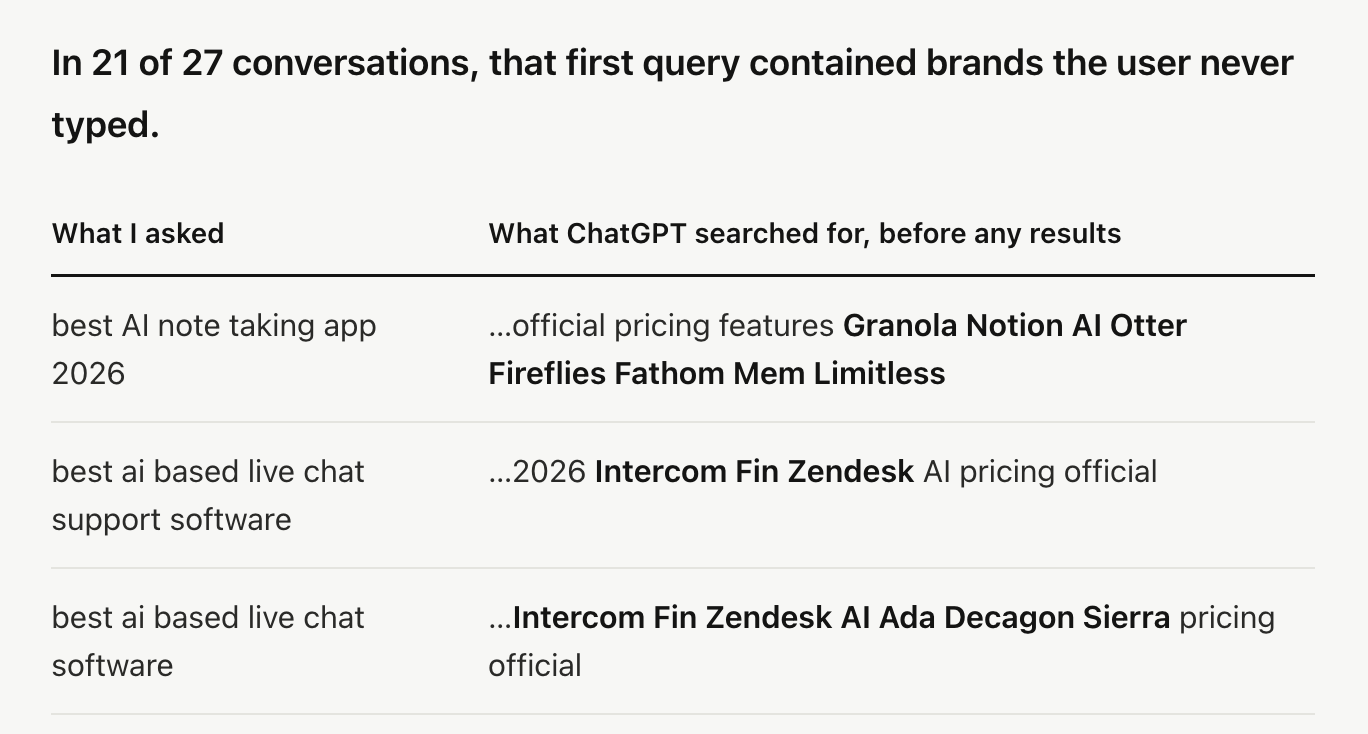
I have to mention that the sample of this study is small — a two-day test on a single account, 57 conversations — so treat this study as directional. The mechanism behind it, however, is visible in every transcript: a brand absent from the opening query is rarely retrieved into the answer later.
What this means for a “normal” brand?
The “page 1” achievement illusion
You could rank #1 on Google for a high-value keyword, but if a user asks ChatGPT for recommendations, the AI will often generate a fan-out query targeting the 3 or 4 big brands it already knows. Your top-ranking page will sit there untouched because the AI never even searched for it.The trust gap
LLMs are trained to avoid hallucinating and to provide safe, authoritative answers. They lean heavily on their pre-trained “parametric knowledge.” If your brand hasn’t been mentioned frequently alongside your target keywords across the web, the LLM won’t risk putting you in its initial fan-out query.Zero-click extraction
When ChatGPT does fetch your page without naming you first, it’s usually just to scrape a factual detail (like a statistic or definition) to support a point about a bigger brand. You become the research source, but the household name gets the customer.
Bad news.
And this raises the importance of brand equity.
In fact, the shortlist of AI queries is assembled from the strength of association between a company and its category — based on what the model already knows. And that association is built mostly off your own properties.
If we check the latest numbers, 85% of brand mentions in AI search come from third-party sources. Of those third-party citations, nearly 90% come from listicles, comparison pages, and review sites. (source).
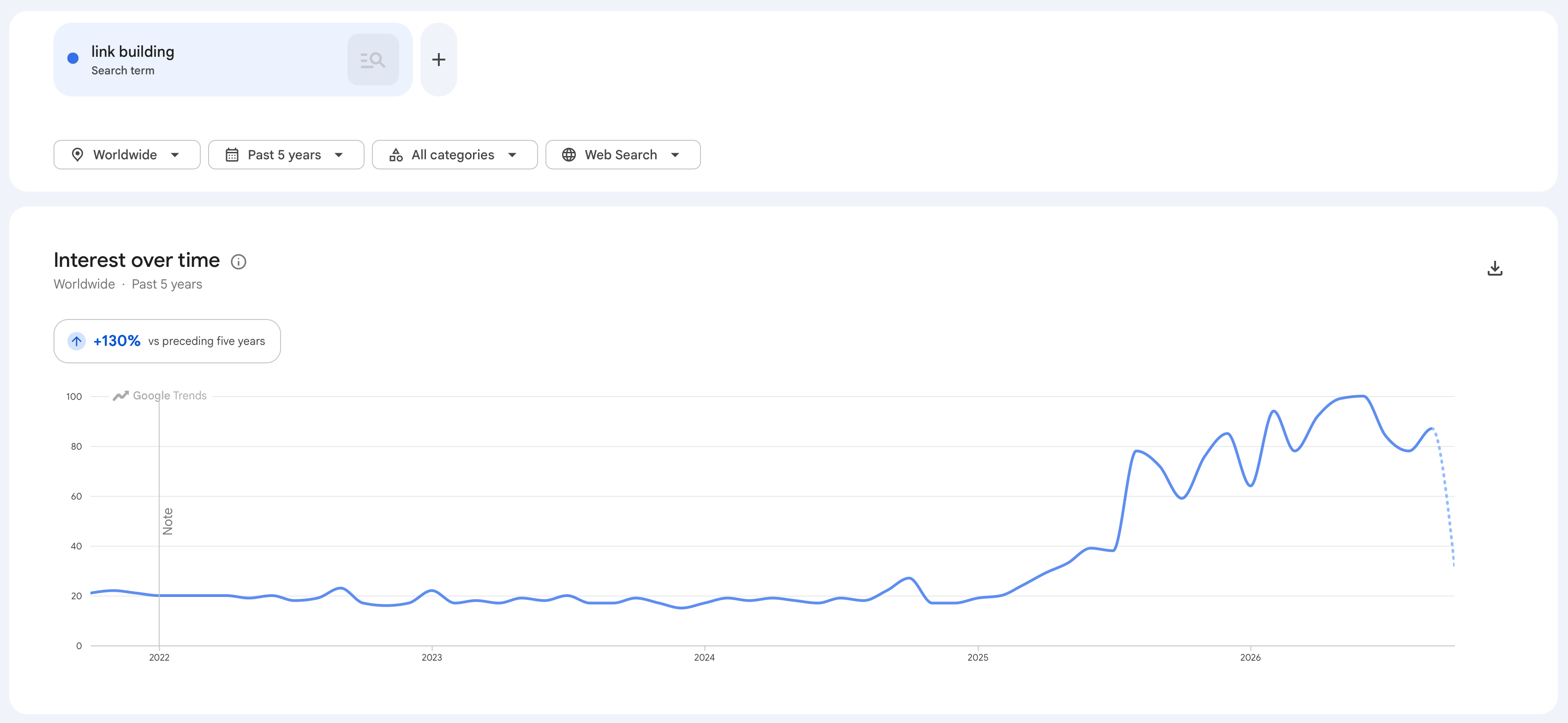
Link building and PR now have a new golden age forming.
Google ranking and AI visibility are losing correlation
For most AI assistants, the link between a site’s Google position and citation is now weak.
When ChatGPT cites a webpage, nearly 90% of the time that page sits below position 21 in Google (source).
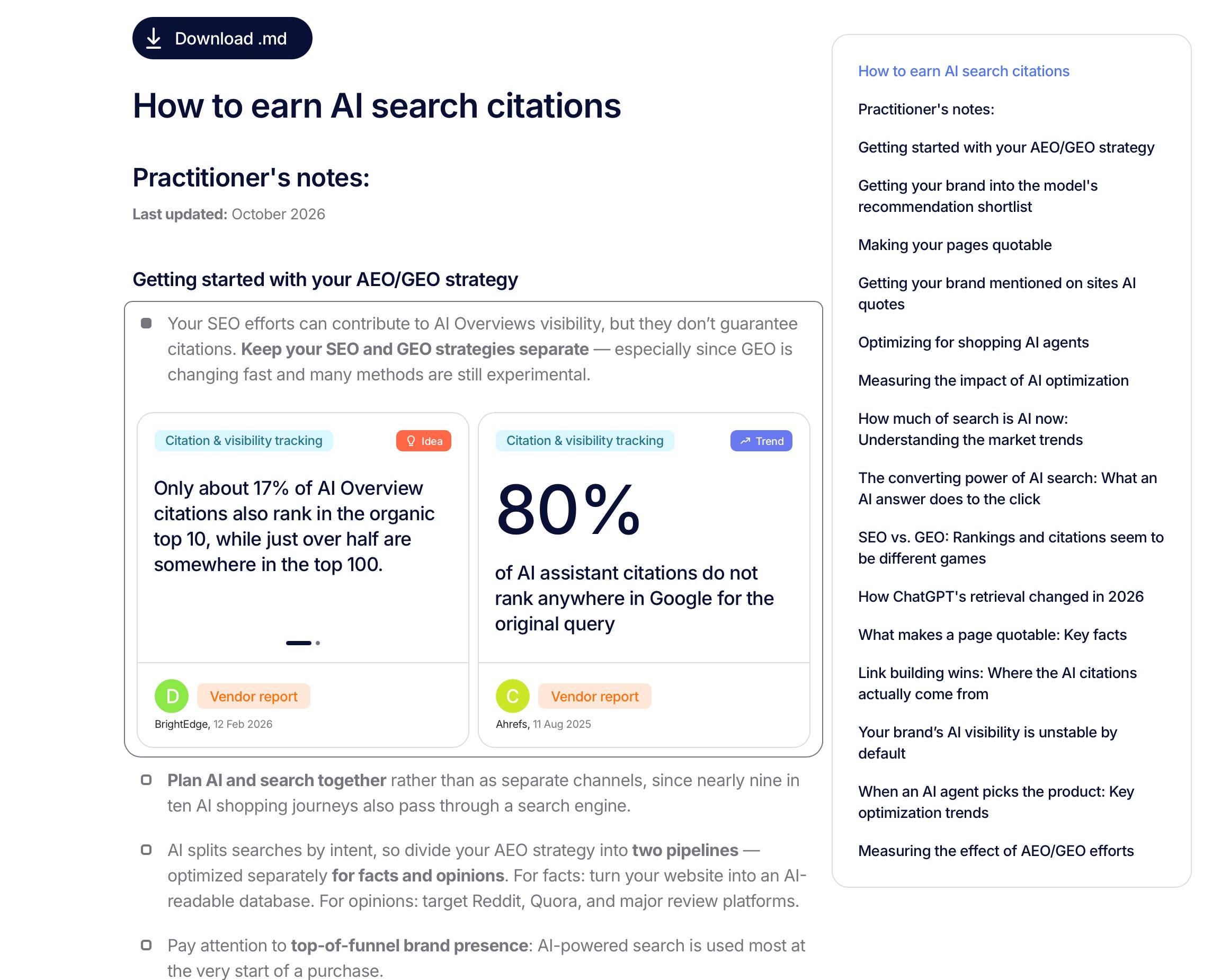
Across a test of 15,000 long-tail queries run through ChatGPT, Gemini, Copilot and Perplexity, roughly 80% of cited links did not rank anywhere in Google for the original query (source).
Inside Google’s own AI Overviews, the relationship is tighter, though the trend points to lower overlap.
In August 2025, Ahrefs reported that AI Overview citations come from Google’s top 10 about 76% of the time (source).
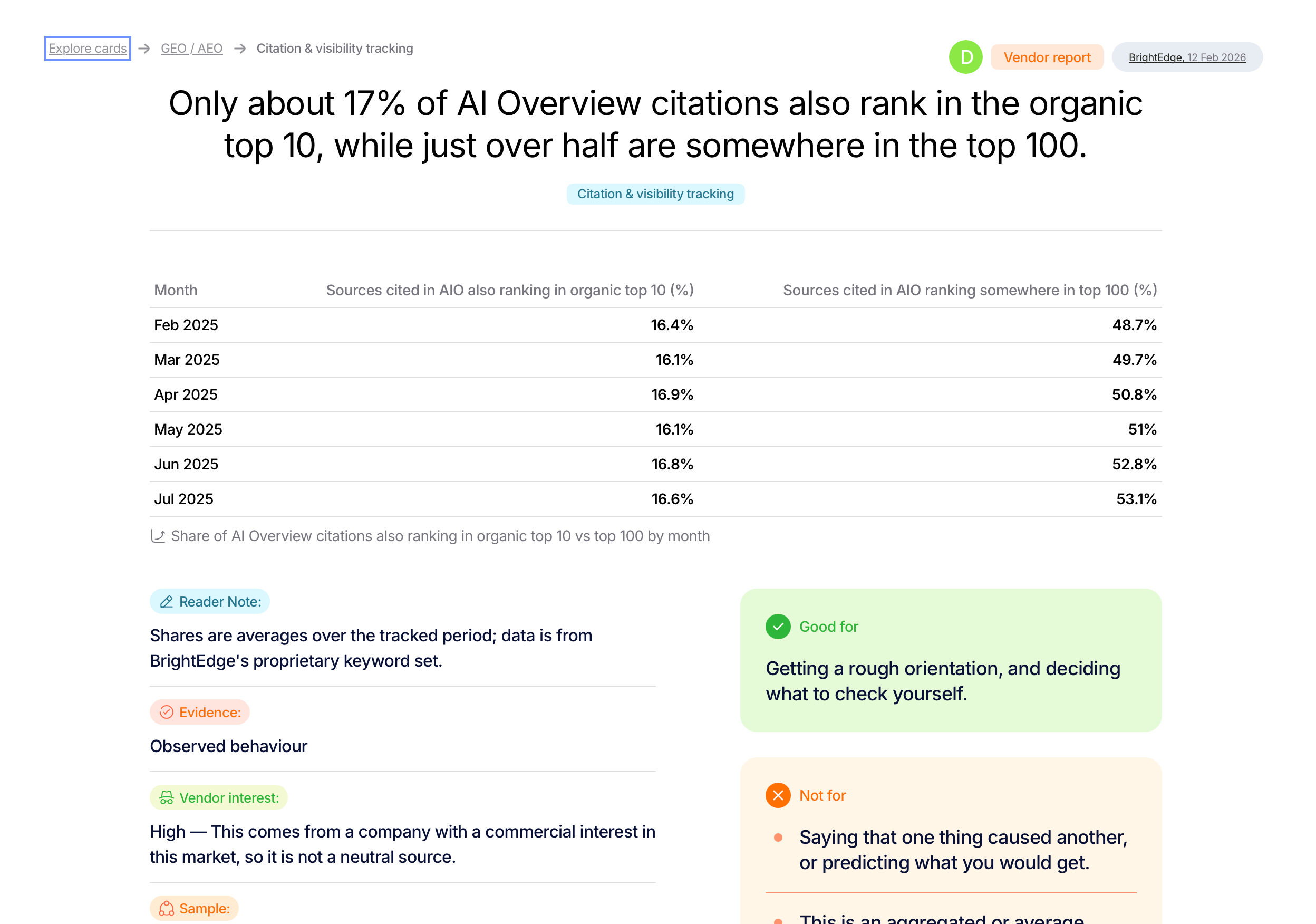
Six months later, BrightEdge — tracking its own keyword set over a year — put the share of AI Overview citations that also rank in the organic top 10 at roughly 17%, with just over half appearing somewhere in the top 100 (source).
Where AI Overviews do appear, they’ve been reshaping the page and user behavior.
They showed up on 48% of one monitored keyword set by early 2026 (source).
99.2% of the keywords that trigger them carry informational intent (source).
On click behavior, the strongest available evidence comes from Pew Research Center, which tracked the actual browsing of 900 US adults. Users clicked a link inside the summary itself on just 1% of visits.
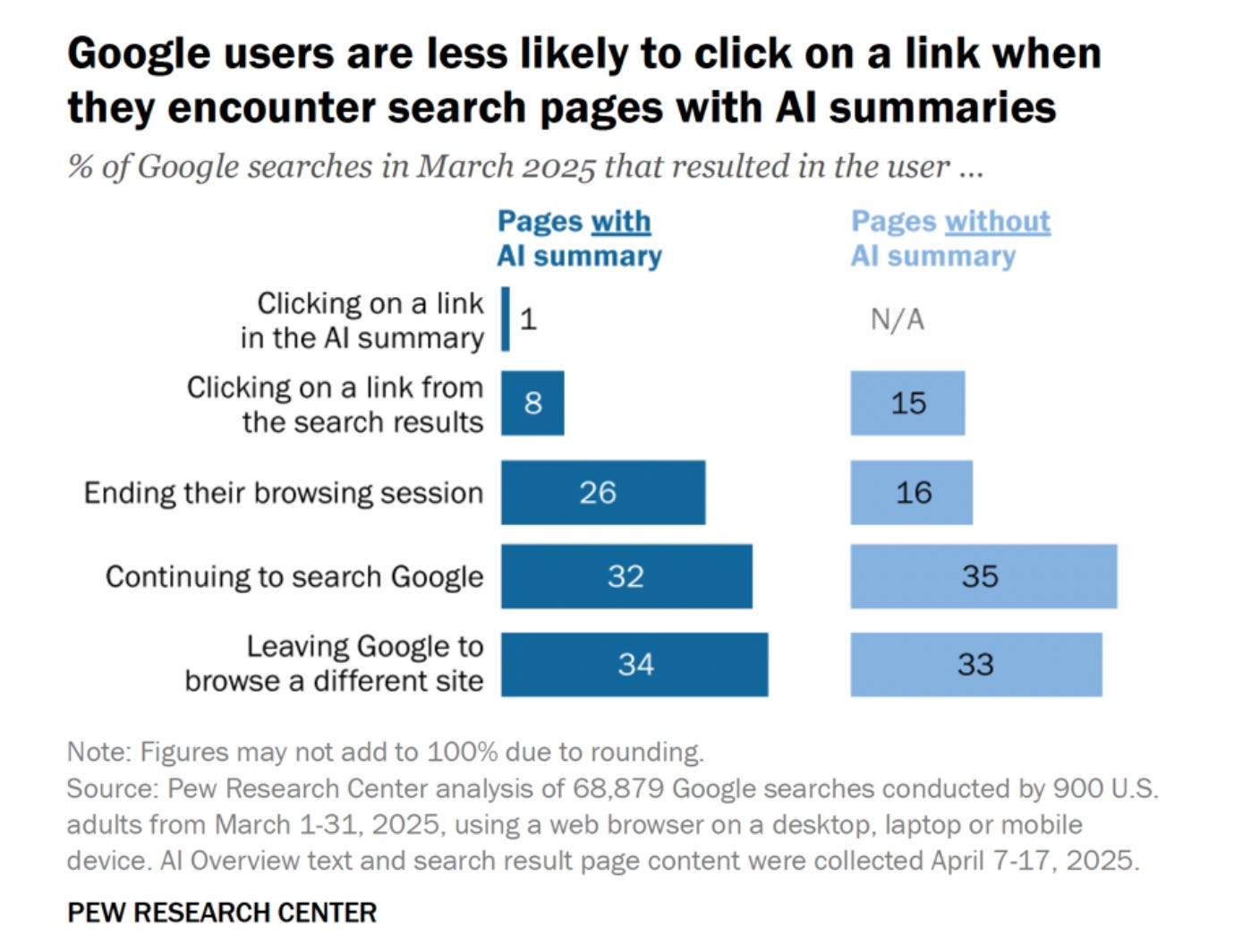
This gap is huge — and the study dates back to 2025. I assume that today, the number of users clicking a link from search (when an AI overview is present) is even lower. AI section is getting taller, and users are getting more used to chatting with Google assistant to refine their request.
Furthermore, AI answers are very inconsistent
The main challenge with AI optimization is that optimization assumes a stable target. AI answers don’t currently provide one.
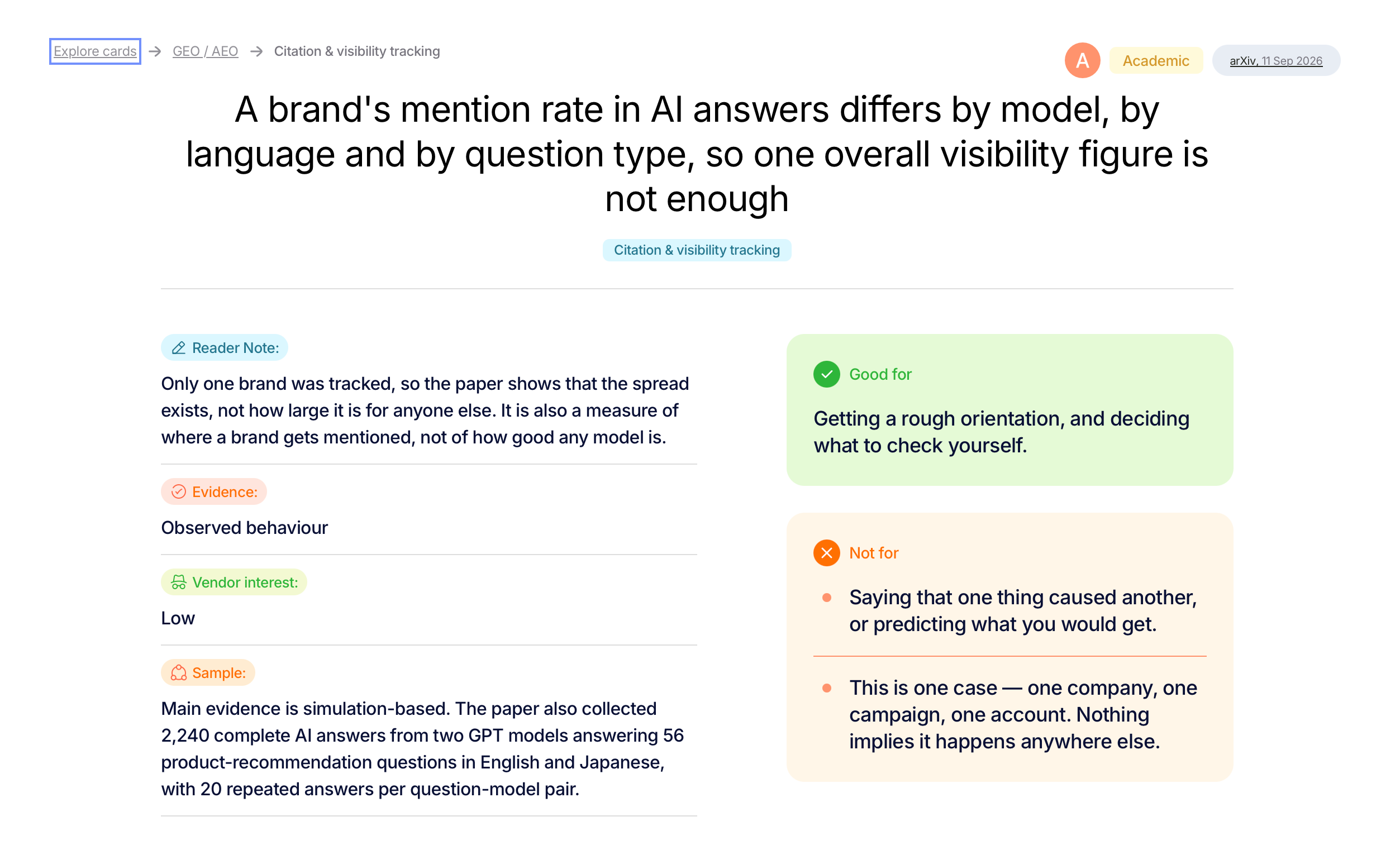
Only 30% of brands stay visible in an AI answer from one run to the next with an identical prompt, and only 20% remain visible across five consecutive runs. Meanwhile, 68% of brand mentions are unique to a single model, meaning a company that appears reliably in one assistant can be entirely absent from another (source).
Visibility also shifts by language and by use case, so a single blended mention rate conceals most of what’s happening (source).
The instability extends to the extracted sources as well.
When ChatGPT builds a site: query for a brand it does not know well, it may guess the domain and aim its search at an address the company doesn’t own, including parked domains (source).
The brand is on the shortlist, but the retrieval step goes to the wrong place, and whatever comes back is attributed to a company that never published it.
Taken together, a single check of a single prompt on a single model on a single day is little better than a coin toss.
Your own pages can be working against you
One pattern from 2026 deserves separate attention because it inverts the intuition behind a common tactic.
When a brand publishes its own “best tools” or comparison listicle and that page is cited in a Google AI Overview, 70% of the time the publishing brand is left out of the answer. Instead, its page is used to recommend competitors. The page earns the citation; the competitors named on it collect the recommendation (ha-ha-ha).
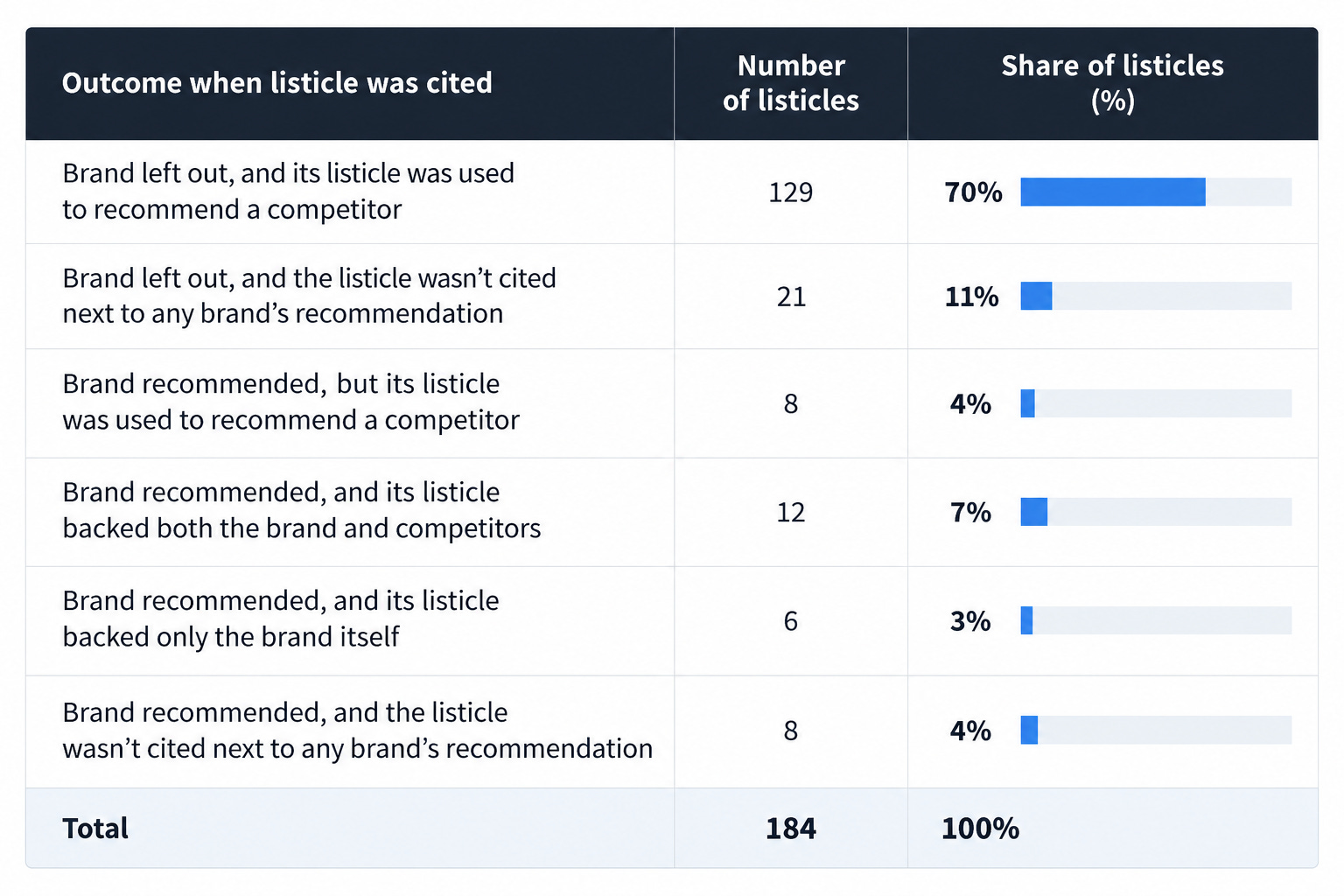
Google catches up with the trend — but in a different way: AI Overviews now cite 38% fewer self-promotional “best of” listicles than they did in June 2026 (source).
The adjacent lesson concerns community platforms.
For a long time, Reddit was the standard answer to where AI systems learn what people actually prefer. Its share of ChatGPT Search citations held steady around 3.83%, then fell from 3.83% to 0.52% between 7 and 17 August 2026 — a drop of 86.4% in ten days (source).
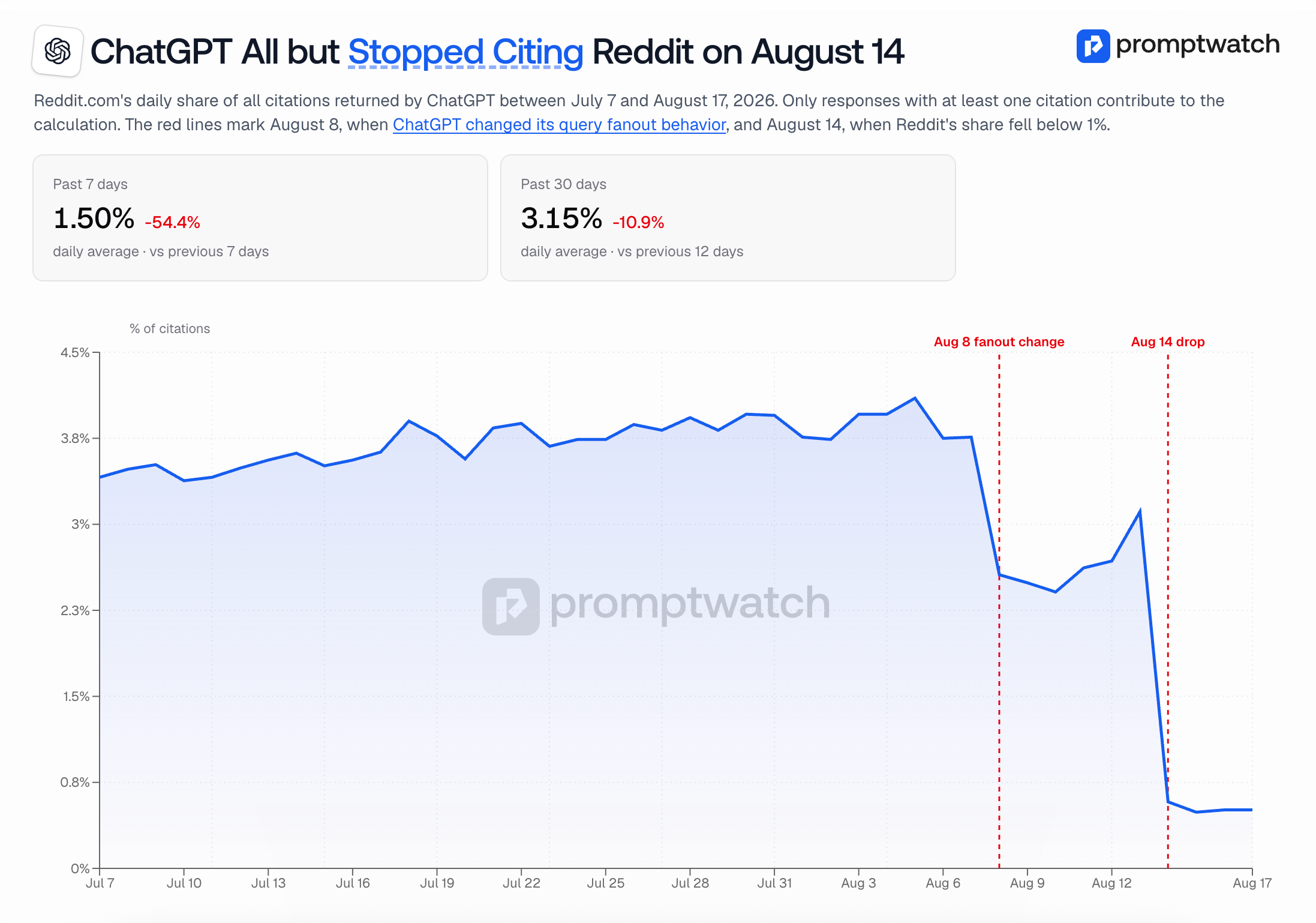
Reddit still remains among the most-cited domains in absolute terms though, but the shift shows how quickly a platform’s weight inside these systems can be re-tuned.
How do we adapt: Brand equity seems to be the new cornerstone
Below are the three key trends I noted down for Q4 2026 AEO strategies.
The retrieval step now begins with a shortlist the model writes itself, assembled from prior associations and dominated by what third parties have published about a category. So increase your focus on bran equity building.
Ranking well on Google doesn’t translate into AI citations, so while SEO and AEO overlap, they are not the same thing.
Some established tactics have inverted, with brand-owned comparison pages now frequently serving competitors. Mentions from third-party websites seem to be a more reliable tactic now.
What to do next: Stacy’s Brain playbook
To get AI to include your brand name in its initial background searches, you need to embed your brand into the LLM’s core understanding of your industry.
1. From “Keywords” to “Entity co-occurrence”
LLMs learn by mapping connections between entities (e.g., “Brand X” ↔ “SEO software”). Your goal is to have your brand name appear as close as possible to your target category across a wide range of high-authority websites.
What we do:
Secure placements in third-party listicles, industry roundups, and comparison pages (e.g., “Top 10 alternatives to [Big Competitor]”). Classic SEO link building, with a bit of PR.
2. Flood digital PR and forums
LLMs rely heavily on structured and unstructured public discussions to understand what real humans prefer. This includes Reddit, Quora, industry-specific forums, and niche media sites.
What we do:
Step one: build team accounts on the relevant platforms and grow their karma and authority.
In 3–4 months, those accounts can start naturally discussing the brand in relevant threads, strengthening “community” consensus around it.
This is highly experimental, though. It’s important that you don’t just start “shilling”—you’ll lose both time and the account :)
3. Dominate category-defining content
If you can’t be the biggest brand in the world, be the absolute, undisputed authority in your specific sub-niche.
What we do:
Create original research reports
Produce proprietary data studies
Publish highly comprehensive “ultimate guides”
When other websites reference your data and credit your brand, it creates a massive web of citations that teaches the LLM your brand is the “seed source” for that specific topic.
Another argument for founder-led growth.
4. Optimize for “Brand + Modifier” searches
Because ChatGPT often searches using the site: operator or specific brand names, make sure your own website makes it easy for the AI to extract data.
What we do:
Build dedicated, cleanly structured pages for intent-heavy searches like [Your Brand] vs [Competitor], [Your Brand] pricing, and [Your Brand] reviews. Use clean schema markup and clear headings.
Stacy’s Brain reads marketing research so you don’t have to, grades every source for methodology, sample and vendor interest. This is how we find evidence for our strategies.