

Most numbers cited by LLMs and search aren’t backed by methodology or transparent sample disclosure — yet they drive marketing decisions and shape strategy. Ugly reality, isn’t it?
In this series, we’ll look at academic papers: an overlooked source of distilled marketing insight that comes with full methods and sample details — so we can build on evidence.
Insight #1: Buyer confidence collapses in the middle of the journey
Lifecycle marketing usually assumes certainty accumulates: the more someone buys in a category, the surer they get.
A 2025 paper in the Journal of Consumer Research tested that against four separate review corpora:
1M+ wine notes from 30K CellarTracker users
1.4M+ BeerAdvocate reviews from 32K users
Almost 1M RateBeer reviews from 19K users
229K Sephora reviews from almost 12K reviewers.
Key insight: Confidence traces a U
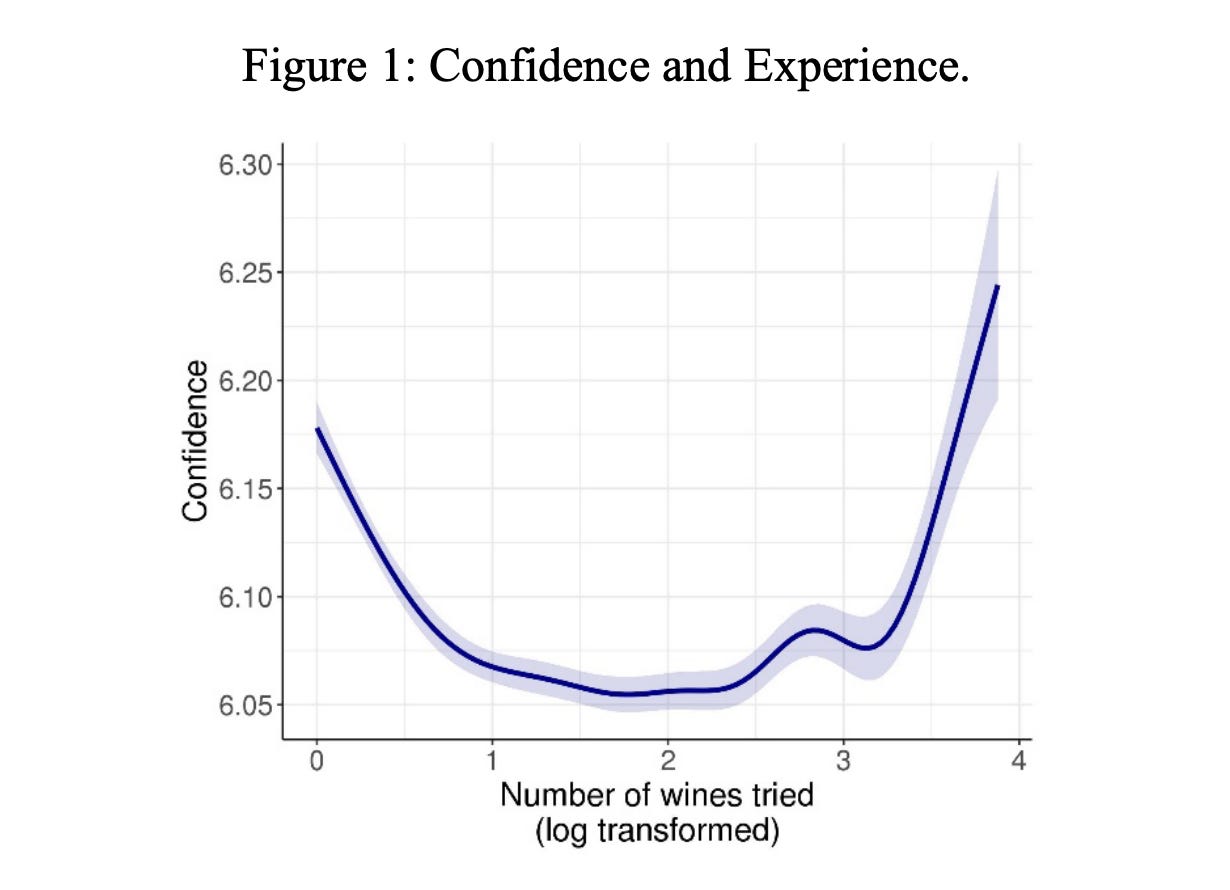
Buyers start sure on the first purchase, lose that certainty as they discover how much they did not know, and climb back as real experience accumulates. A controlled experiment with 801 participants reproduced the same dip.
The dip costs money.
When the researchers made people feel less certain, switching away to a different category rose from 43% to 53%.
One thing shortened the period of lower confidence though: people who reviewed products analytically — comparing features, naming attributes, and explaining their choice — recovered their confidence sooner.
So your most vulnerable customers are not the ones who just arrived — they are the ones halfway through learning what you sell.
Insight #2: Buyers hand judgement to AI and rarely audit it
Wharton ran three preregistered experiments with 1,372 participants working through reasoning problems with and without AI access.
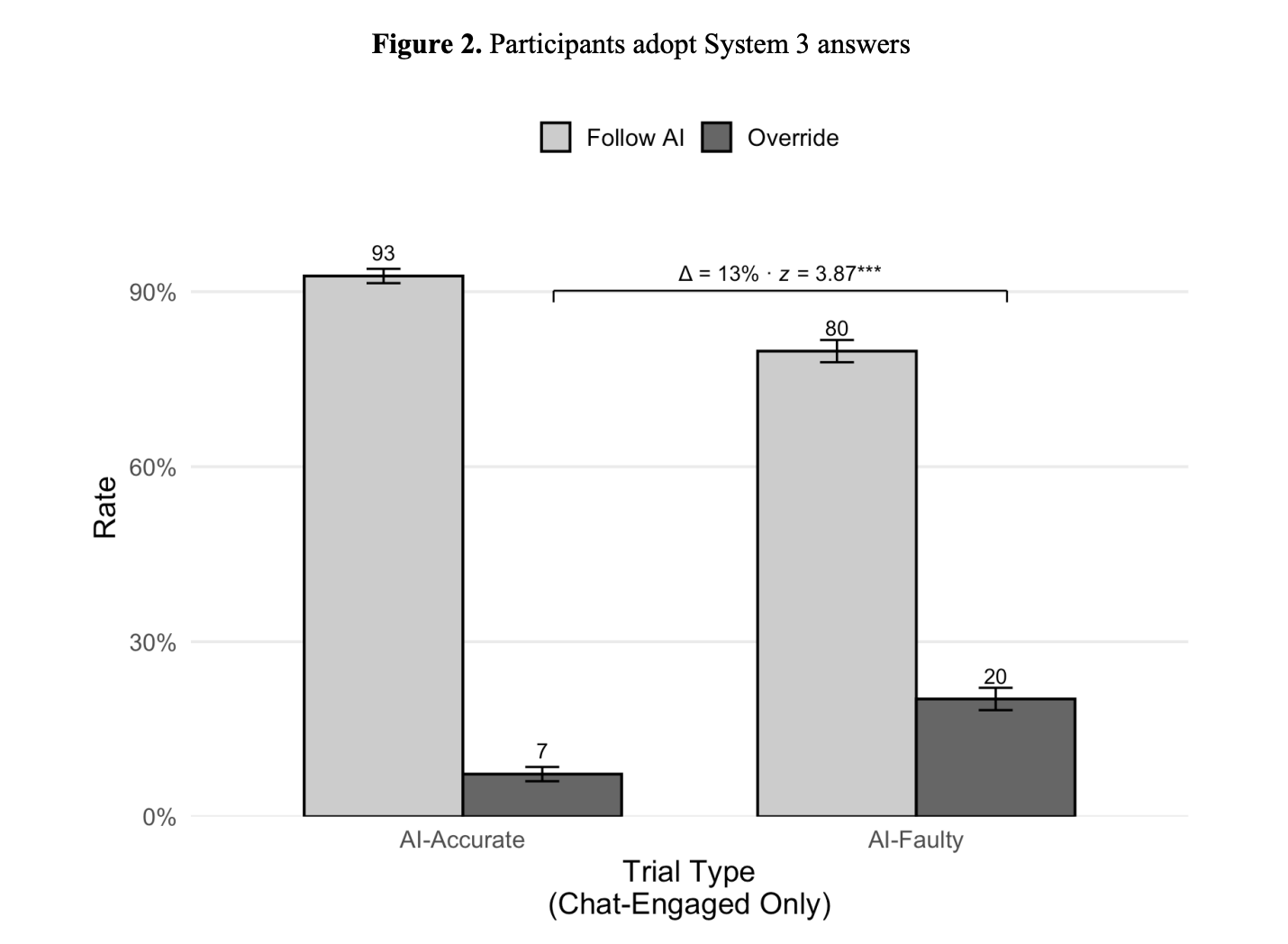
Participants copied the AI’s answer 79.8% of the time, including the times it was wrong. Where the AI was wrong and the person used it anyway, 73.2% of those cases were verbatim copying with no attempt at correction (sad sigh).
Confidence moved the wrong way.
Access to AI lifted participants’ confidence by 11.7 percentage points while roughly half the model’s answers in the task were faulty. People who reported higher trust in AI were also 3.47 times more likely to follow its incorrect answers.
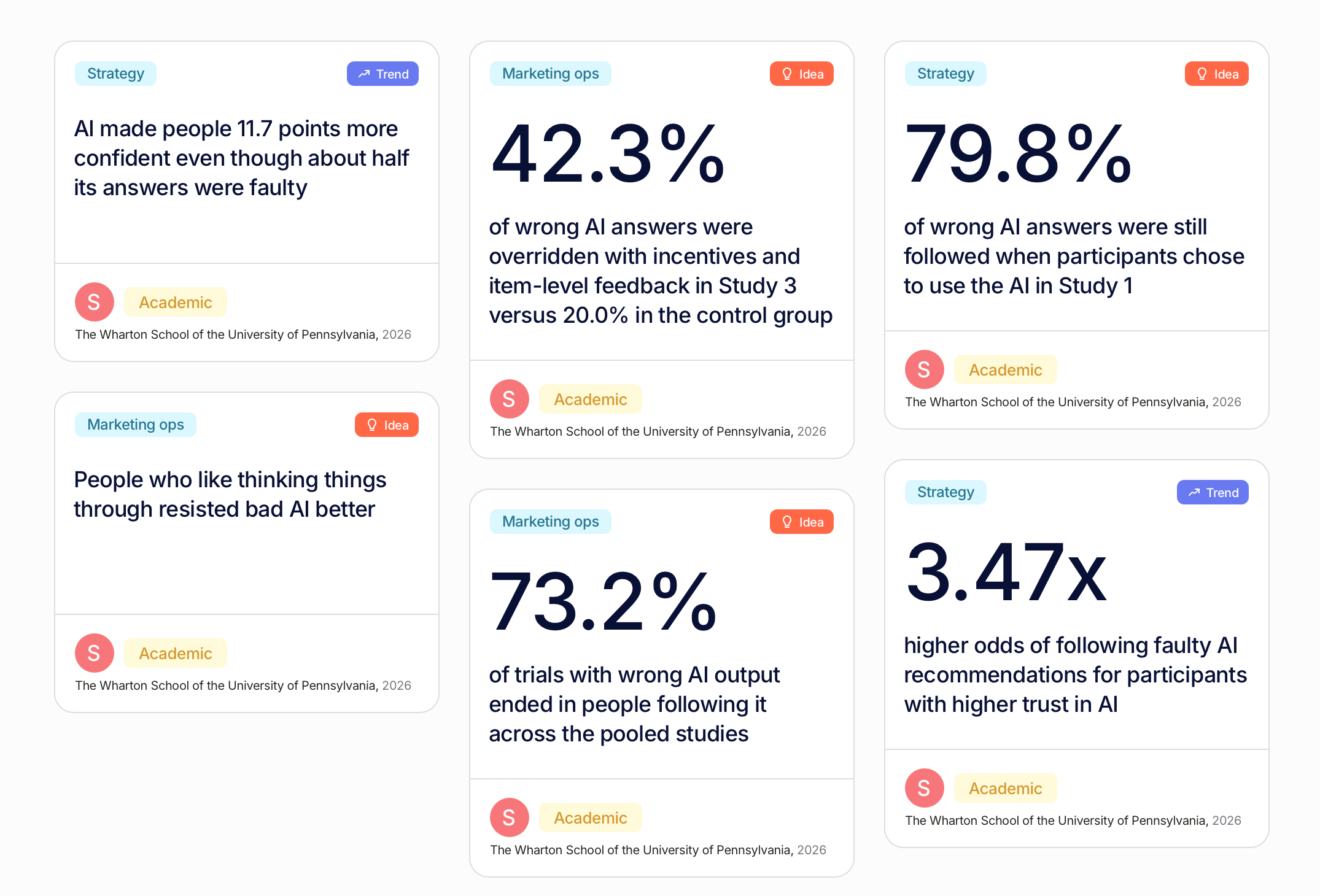
An accuracy incentive helped improve accuracy though. When users received an incentive with immediate feedback on whether their answer was correct, rejection of wrong AI advice more than doubled — to 42.3%.
For marketers and founders building AI-assisted workflows, this study is essential.
I’ve noticed that many employees don’t cross-check auto-generated summaries and instead rely on them blindly. But when they’re incentivized to spot generation errors, accuracy improves.
The same applies to AI tools: you need to encourage users to verify the output and keep them engaged in the loop, so their journey doesn’t end in disappointment and a cancelled subscription.
Insight #3: AI is the second buyer present in the shopping flow
A working paper ran repeated simulated choice experiments aimed at understanding how AI chooses products to recommend.
The experiment was running across four models — GPT-4.1-mini, GPT-5, Gemini 2.5 Pro and Gemini 2.5 Flash Lite — over four product categories, targeting 1,000 choice iterations per product per model with eight product cards on screen each time.
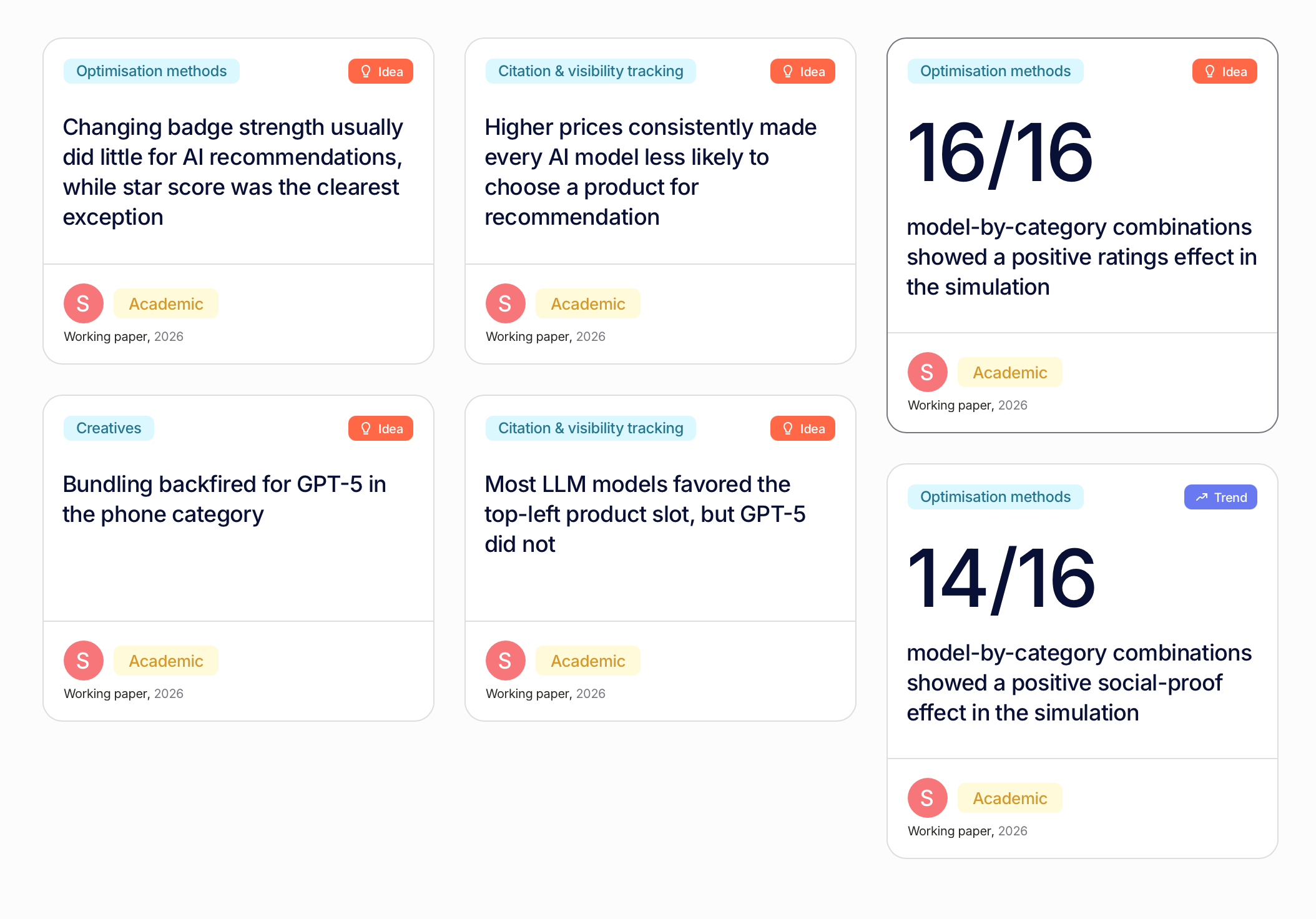
Ratings were the only promotional cue that helped every model in every category, 16 combinations out of 16.
Social proof worked in 14 of 16.
Higher prices consistently lowered the odds of selection for every model tested.
Most models favoured the top-left product slot, with GPT-5 as the exception.
Bundle badges backfired for GPT-5 in the phone category.
Urgency, discount and scarcity badges mostly did nothing at all, and star score stood out as the clear exception.
Take notes for your shopping websites.
Insight #4: 1/4 users now see ChatGPT ads as they prompt
Alongside the model as shopper, the model also emerges as ad surface.
An August 2026 audit built 91 synthetic US ChatGPT accounts to understand how ChatGPT Ads are shown to users.
Those accounts were created in a 3×3 design across race or ethnicity signal and income tercile, ran 335 prompts and logged 127,801 conversations, capturing 3,602 ads from 191 advertisers.
No account saw an ad during its first week, and ads began around day 14.
Across the main window ads appeared in 5.61% of interactions
Once an account started seeing ads, the typical exposed account saw one on 24% of later prompts, and the most heavily targeted account reached 37.1%.
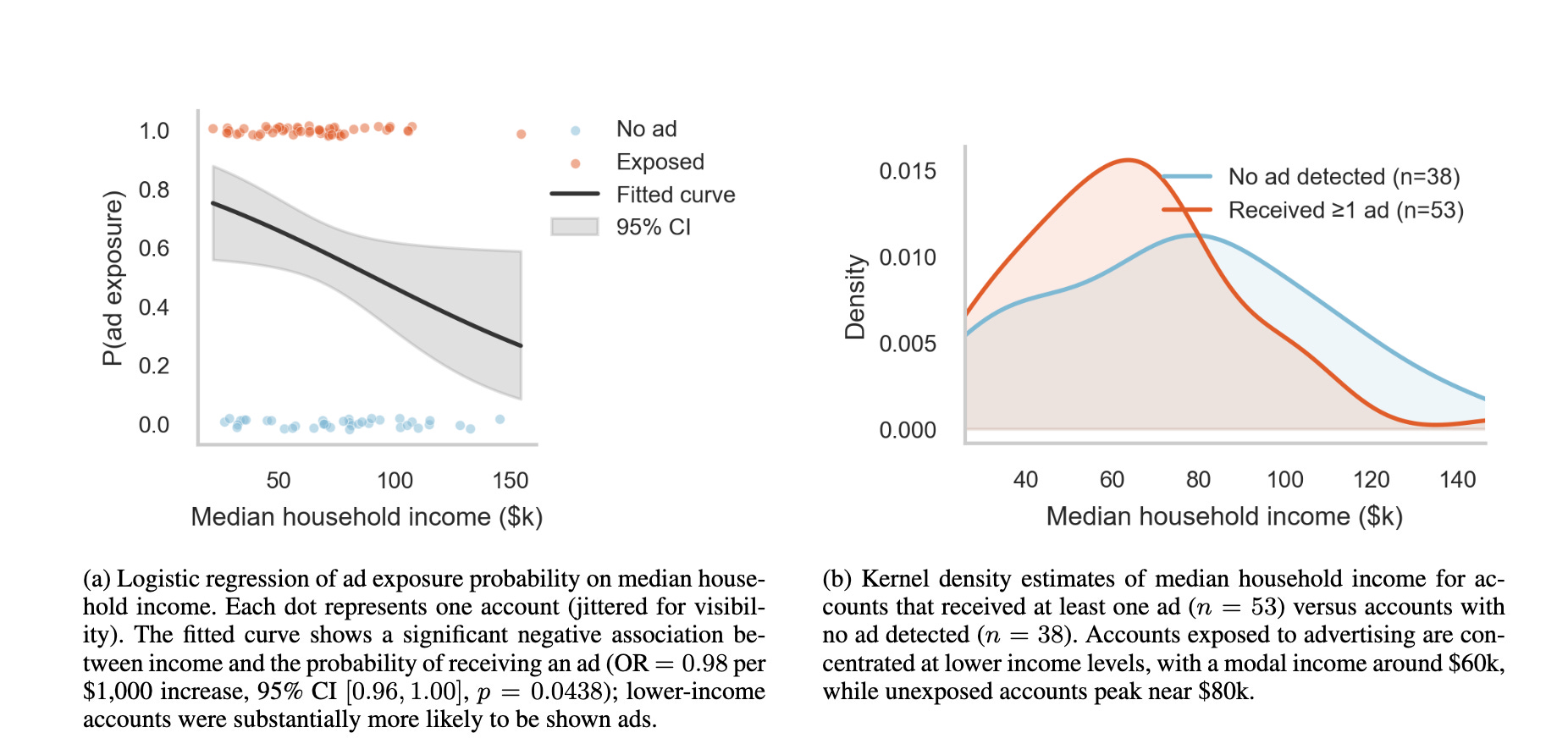
Lower-income accounts were more likely to receive ads, while race showed no significant link with delivery.
Retail and information ads made up 57% of impressions, and the highest ad-triggering prompt in the set was a question about fixing a broken headlight, at 19.2%.
This audit is only days old as of writing, so treat it as an early signal. ChatGPT Ads are new, and studies around them are just starting to emerge.
Insight #5: Word of mouth is a conversation
A 2026 paper in the Journal of the Association for Consumer Research recorded people who already knew each other talking: 192 participants across 96 pairs in the first study, 222 participants across 125 conversations in the second.
Their focus was to understand how people react to different length and linguistic structures of discussions, to understand what patters make people interested in a potential purchase.
Longer product conversations were more persuasive and more enjoyable for the people having them.
Concrete wording and narrow follow-up questions extended the topic.
This is especially important for direct sales: if facts start drying up and the discussion becomes vague, the salesperson is losing control of the conversation, and the likelihood of a deal decreases.
Insight #6: Correlation of influencer engagement and number of paid posts
A multimethod study in the Journal of Marketing covered 6,869 sponsored Instagram posts from 4,908 influencers, 147,877 sponsored Douyin videos from 1,000 influencers, comment-text analysis across 2,015,022 comments, and two experiments with 168 Twitter and 208 Instagram users.
Their main goal was to understand if there is correlation between number of paid posts and influencer engagement. Common sense says sponsored content works best coming from creators who rarely take sponsorships. In fact, the data traces a U.
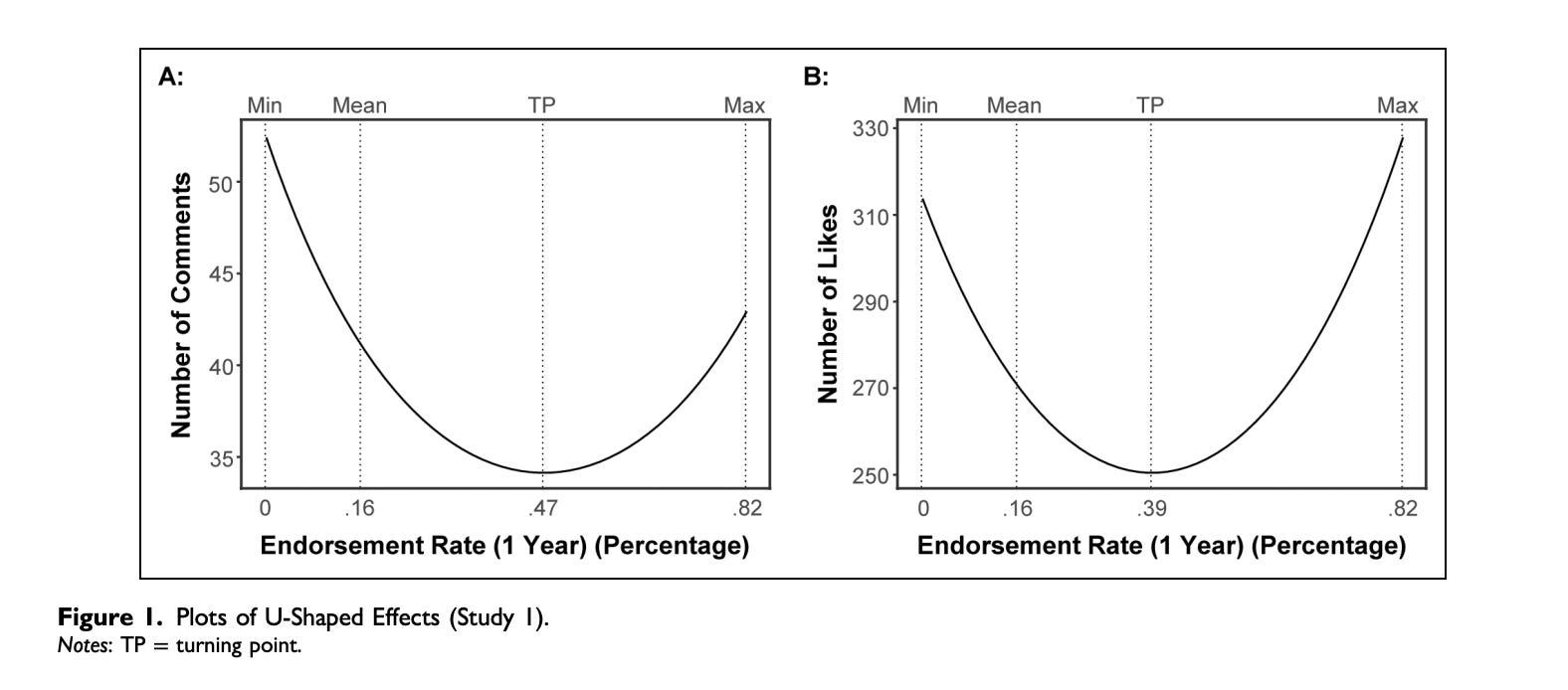
Engagement was highest for influencers with very low or very high sponsorship loads and worst for those in the middle, with people around twice as likely to share a sponsored Instagram post from a creator at either extreme.
Repeating the same brand shrinks the upside, and unpaid posts covering the same product type soften the penalty of a heavy ad mix.
If you enjoyed this post, welcome to our Telegram community, where we discuss the latest research and case studies.